

Stablecoin Payouts for Businesses: How to Pay Global Affiliates, Suppliers and Contractors
Share
TL;DR: Stablecoin payouts help businesses pay overseas suppliers, affiliates and contractors in assets such as USDT and USDC. CCPayment supports individual and batch payments, with withdrawal approvals and payment records to help finance teams manage each payout run.
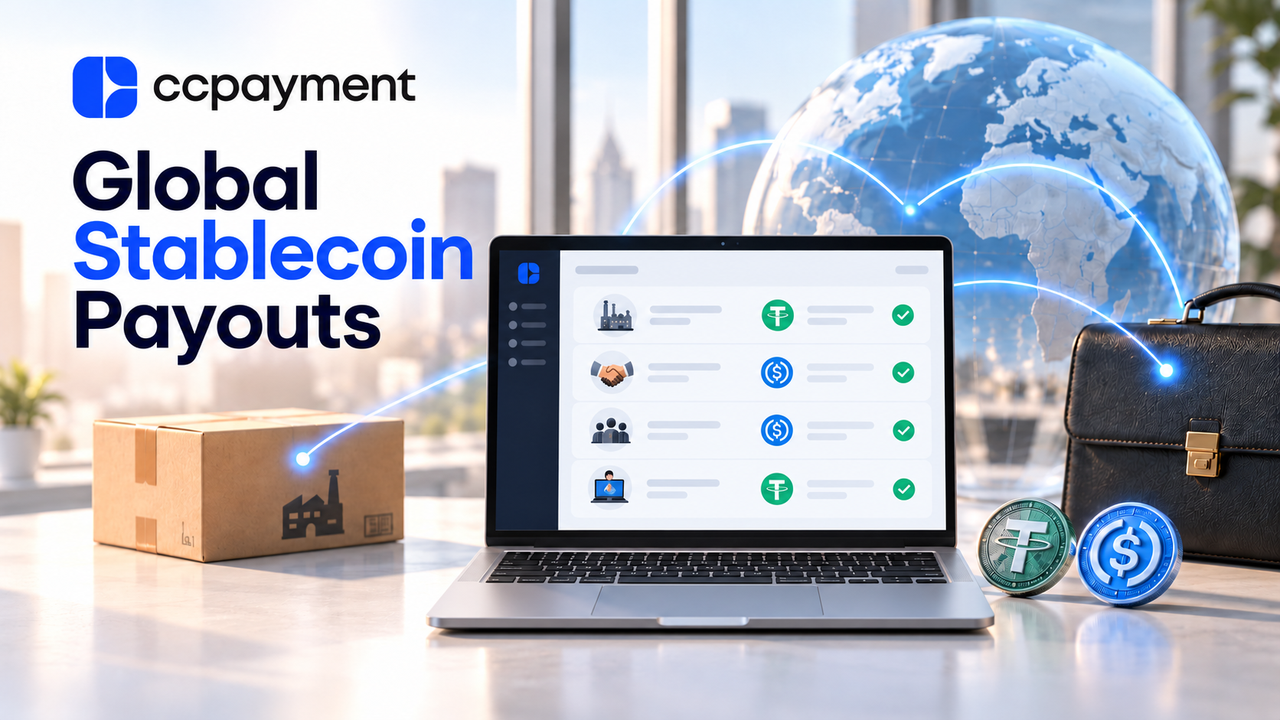
An overseas supplier needs an invoice settled. Affiliate commissions are due on Friday. A contractor is waiting for payment before starting the next project. For the finance team, each payment may involve a different bank, currency and processing schedule. Add more recipients, and the work quickly piles up: entering payment details, checking transfers and answering, "Has my payment been sent?“
Stablecoin payouts give businesses a consistent way to pay recipients who accept digital assets across different markets. Funds are sent to supported wallets through an agreed blockchain network, and payout instructions can be submitted outside traditional banking hours. Completion time still depends on approval settings, blockchain conditions, and the selected network. For finance teams handling regular cross-border disbursements, this can make payment day easier to plan as the recipient list grows.
What Are Stablecoin Payouts?
Stablecoin payouts are outgoing business payments made with tokens designed to track a reference asset, usually the US dollar.
USDT and USDC are common examples. Companies use them to settle supplier invoices, distribute affiliate commissions and partner revenue shares, and pay contractors directly to supported wallets.
In this context, a payout is an outbound payment from the business balance. It may be sent as an individual transfer or included in a scheduled batch with other approved payments.
Where Businesses Use Stablecoin Payouts

Supplier and Vendor Payments
Companies working with overseas vendors may need to settle inventory purchases, software subscriptions and marketing invoices across several countries. When vendors accept digital assets, businesses can pay suppliers with stablecoins using an agreed asset and network, giving finance a more consistent payment method across giving finance a more consistent payment method across supported markets, subject to the business’s and recipient’s applicable requirements. If an invoice is priced in fiat, both parties should agree on how the stablecoin amount will be calculated and what amount settles the invoice in full.
Affiliate and Partner Payouts
Affiliate networks regularly distribute commissions that vary by campaign, earning period or revenue-sharing agreement. As the network grows, submitting every transfer separately adds more work to each weekly or monthly payout cycle. Once the commission statement is approved, the payments can be grouped into a batch payout run.
For iGaming and esports businesses, this can include affiliate commissions and partner revenue shares. Keeping each payout connected to its earning period also makes it easier to answer a partner’s payment question without reviewing the entire batch.
Contractor and Remote Team Payments
Stablecoin payments to contractors can cover monthly invoices, completed project milestones or one-off services from overseas developers, designers and consultants. They are particularly useful when remote professionals already accept digital assets and work across different countries and banking schedules.
Marketplace and Platform Disbursements
Marketplaces and digital platforms may distribute earnings to hundreds of sellers, creators or service providers. The platform calculates eligibility and amounts according to its own settlement rules, while the payout integration executes the approved transfers. Crypto payouts for businesses allow operations teams to manage these distributions at scale while retaining an individual payment result for each recipient.
How Do Stablecoin Payouts Work?
Choose the Correct Stablecoin and Network
Confirm that the recipient's wallet or exchange supports the selected stablecoin on the selected network, including any required memo or tag. Similar-looking addresses may be used across different blockchains, so the network should be confirmed directly with the recipient. Prepare the wallet details, payout amount and internal reference, then make sure the business has enough available balance.
Send Individual or Batch Payouts
Individual payouts work well for one-off invoices, while batch payouts are better suited to recurring commission lists and other larger distributions. Once the recipients and amounts are approved, the payment instructions can be submitted through the payout provider's API. For global crypto payouts, keep an internal reference linking each transfer to its invoice or commission statement. Assign a unique internal order ID to each payout and query the existing payment status before resubmitting it to avoid duplicate transfers.
Track and Reconcile Transactions
Track each payment through to its final result and retain the transaction hash once available. Retrieve the payment records through the Dashboard, API, or available financial-report exports, then use internal references to match completed transfers with supplier invoices, affiliate commissions or contractor fees. Pending or failed payments can then be reviewed separately, while finance reconciles the completed obligations.
What Should Businesses Look for in a Stablecoin Payout Solution?
Compare providers against what your team needs to do on payment day:
- Stablecoin and network coverage: Does the solution support the combinations your recipients actually use?
- Payout scale: Can it handle both individual payments and recurring batch lists without requiring every transfer to be submitted separately?
- Recipient validation: Can it check withdrawal address and memo formats before submission?
- Approval controls: Can finance review batch requests before funds are released?
- Tracking and reconciliation: Can the team view individual payment statuses and transaction hashes, then export the records?
- Fee structure: Are platform withdrawal fees and blockchain network costs clearly explained?
- Security controls: Are withdrawal address controls, API IP whitelisting and secure credential management available?
Also confirm that the provider can serve your business and intended recipient markets. The BIS report on stablecoin arrangements highlights jurisdictional differences affecting cross-border use, while the FATF's virtual asset guidance and its 2026 report on stablecoins and unhosted wallets address risk-based controls, customer due diligence, transaction monitoring, and illicit-finance risks. These resources should be considered alongside the current requirements in the markets relevant to your payout operations.
How CCPayment Supports Business Crypto Payouts

- Prepare your payout run Pay supplier invoices or contractor fees individually, or use CCPayment's Batch Withdrawal API to organize up to 500 recipient payments under one master order. The initial request supports up to 50 sub-orders, with additional sub-orders appended in groups of up to 100 before confirmation.The optional batch validation API can check address and memo formats before submission.
- Review batch requests before release When bulk withdrawal approval is enabled, batch requests that meet the configured approval rules are routed to the assigned approvers before execution.
- Follow payment results and reconcile Once the payments are released, track each recipient's status, amount, receiving details and transaction hash in the merchant dashboard. Export the records and match them to invoices or commission statements in your own accounting system.
Standard individual and batch withdrawals carry 0% platform withdrawal fees; blockchain network fees apply.Simplify your next global payout run. Get started with CCPayment today!
Crypto Adoption for Business 2026
Deep dives into Web3 payments, industry trends, and how to scale your global commerce with zero-code integrations.
FAQ
Q1: Why do businesses use stablecoins for global payouts?
A:Stablecoins give businesses a consistent way to pay overseas suppliers, affiliates, and contractors who accept digital assets. They can be sent across supported blockchain networks outside traditional banking hours, helping companies coordinate cross-border payments across different markets and payment schedules.
Q2: Can stablecoin payouts reduce cross-border payment costs?
A:They can reduce some of the intermediary and administrative costs associated with international payouts, especially when recipients already hold USDT or USDC. Businesses should still compare platform fees, blockchain network costs, conversion expenses, and the recipient’s eventual off-ramp costs before choosing a payout route.
Q3: How do batch stablecoin payouts improve operational efficiency?
A:Batch payouts allow finance teams to organize many approved payments under one payout run instead of submitting every transfer separately. This can reduce repetitive work when paying affiliate commissions, marketplace earnings, contractor invoices, or partner revenue shares, while retaining an individual result for each recipient.
Q4: How can businesses keep stablecoin payouts secure?
A:A secure payout process should combine recipient validation, internal approval rules, address controls, access permissions, and transaction-status verification. With CCPayment, businesses can validate batch recipient details and configure separate approval workflows for individual and bulk withdrawals before funds are released.
Q5: How do stablecoin payouts help finance teams reconcile payments?
A:Each payout should carry an internal reference that connects it to the relevant invoice, commission statement, contractor fee, or settlement period. Transaction records, recipient-level statuses, network fees, and on-chain hashes give finance teams the information needed to separate completed, pending, and failed payments and reconcile them with internal accounting records.