

Crypto to Fiat Payment Gateway: How Businesses Accept Crypto and Settle in Fiat
Share
⏱️ TL;DR: A crypto-to-fiat payment gateway helps businesses connect crypto payments with the fiat money they still use for payroll, suppliers, and operating expenses. That process may involve three different services: a payment gateway to accept and confirm the payment, stablecoin conversion to manage the assets received, and a fiat off-ramp to move eligible crypto balances into the banking system. This guide explains how the workflow fits together and what finance teams should evaluate before choosing a provider.
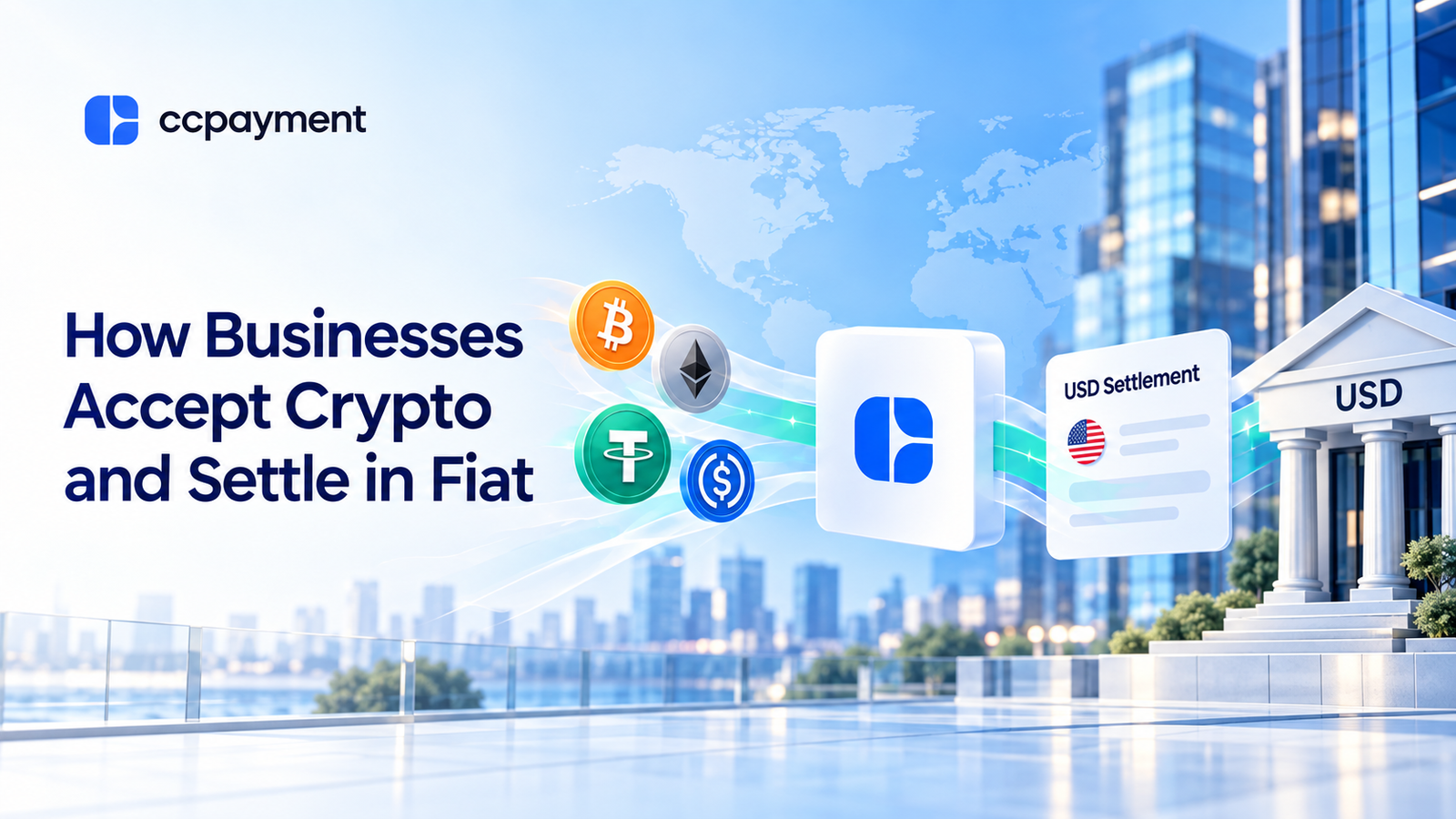
A cross-border ecommerce company may accept BTC or USDT from customers in several markets while paying suppliers in USD. The same mismatch appears in SaaS and B2B services, where international clients may prefer crypto even though payroll, cloud infrastructure, taxes, and other operating costs remain fiat-denominated.
Adding crypto at checkout solves the collection side of the problem. Finance still has to decide what happens after the payment arrives, how much crypto exposure the business wants to keep, and how revenue will eventually reach its banking workflow. A crypto to fiat payment gateway is most useful when those steps can be managed as a connected process rather than through unrelated wallets, exchanges, and settlement providers.
What Is a Crypto-to-Fiat Payment Gateway?
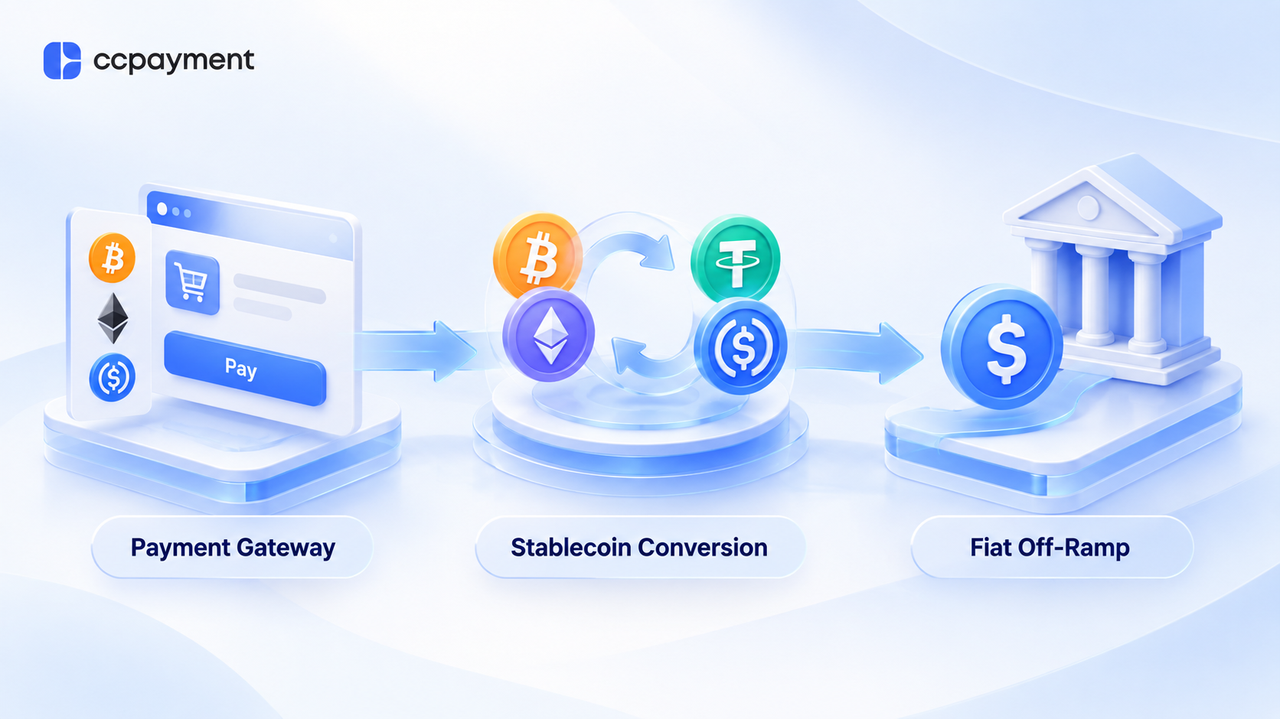
A crypto to fiat payment gateway allows a business to accept cryptocurrency while providing a route for eligible revenue to move toward fiat settlement. Understanding that route first requires separating three services that are often grouped together.
A payment gateway handles the customer's payment. It provides the payment instructions, detects and confirms the blockchain transaction, and connects the payment with an order, invoice, subscription, or customer account. This is what a business needs when the immediate problem is accepting crypto and knowing when a customer has paid.
Stablecoin conversion addresses a different issue. A merchant may accept BTC, ETH, or other supported assets but prefer to keep payment revenue in USDT or USDC. Conversion changes the asset the business holds; it does not move the money into a bank account.
A fiat off-ramp provides that final connection to traditional banking. It converts an eligible digital-asset balance into fiat and settles the proceeds through supported bank routes.
A business may need only one of these services or all three. A company that already receives USDT, for example, may have little need for stablecoin conversion but still need a reliable off-ramp. An ecommerce merchant accepting several volatile assets may need the payment gateway and automatic conversion before it ever reaches the fiat-settlement stage.
How Does Crypto-to-Fiat Payment Processing Work?
Accept and Confirm the Crypto Payment
The workflow starts when a customer pays through a crypto checkout, invoice, payment link, or assigned deposit address. The gateway monitors the relevant blockchain and confirms the transaction, while the merchant connects the payment record to its own order, subscription, user balance, or internal ledger.
For businesses collecting internationally, blockchain-based payment rails can reduce some of the intermediary steps found in conventional cross-border payments. A March 2026 Federal Reserve analysis notes that correspondent-banking chains can add time, cost, and limited payment visibility, while stablecoins may shorten some intermediary steps. The same analysis also makes clear that access, compliance, FX, and fiat conversion still affect the economics of the final payment.
Convert Crypto to Stablecoins When Needed
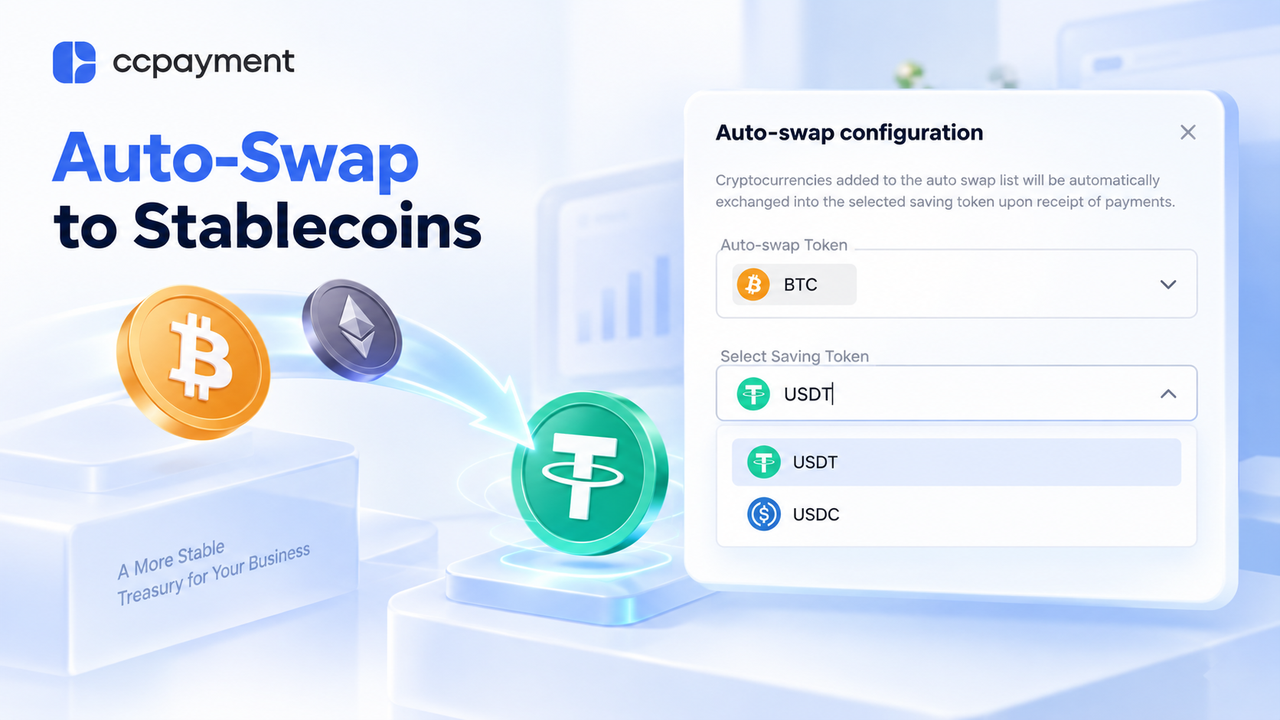
Accepting a volatile cryptocurrency does not mean the merchant has to keep it on its balance sheet. If products, budgets, and supplier obligations are priced in dollars, the value of BTC or ETH can move between the time a payment arrives and the time finance needs to use it.
Automatic stablecoin conversion is useful when a business wants to offer broader crypto payment choice without managing several volatile treasury balances. CCPayment's Auto-Swap lets merchants configure supported incoming assets for conversion into a selected saving token, such as USDT or USDC.
This lets payment choice and treasury policy remain separate. Customers can use supported assets they already hold, while finance can consolidate selected revenue into a smaller set of stablecoins.
Convert Stablecoins to Fiat
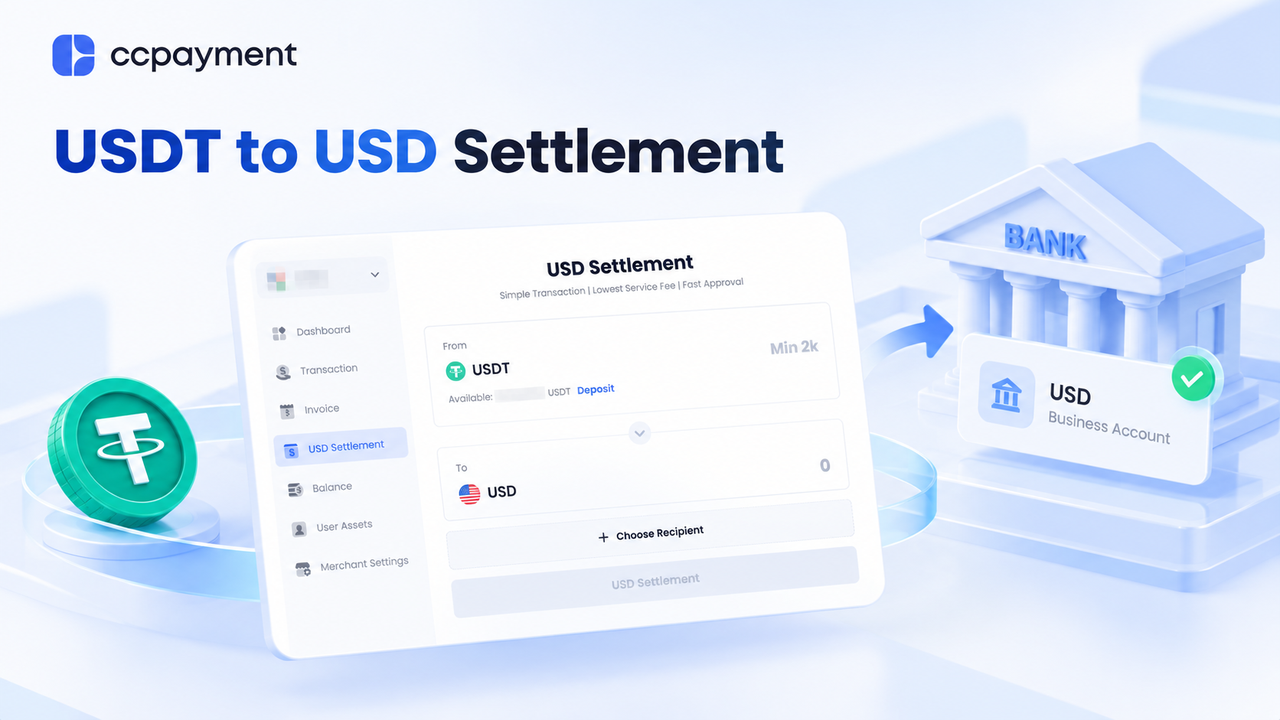
Holding USDT or USDC can reduce volatility exposure, but it does not necessarily provide the bank liquidity a business needs for daily operations. Payroll, taxes, suppliers, and many other expenses still require money in a bank account, which is where a crypto off-ramp for businesses becomes relevant.
The cost of this final leg should be evaluated as part of the whole workflow. The BIS Annual Economic Report 2026 notes that the performance of stablecoins as cross-border payment instruments is uneven after fees, spreads, and on/off-ramp costs are included. Faster on-chain settlement does not automatically mean a cheaper end-to-end business payment.
Why Businesses Use Crypto-to-Fiat Payment Gateways
An ecommerce company can serve customers who already hold crypto without requiring the finance team to operate entirely in crypto. SaaS providers and B2B service businesses can do the same for international invoices while keeping their normal USD budgeting and banking processes.
The operational problem becomes more obvious when these steps are fragmented. A business may collect crypto through one provider, move it to an exchange, perform a conversion, withdraw funds to a bank, and then reconcile several independent records. Each handoff adds another balance, fee, approval process, and transaction reference for finance to manage.
This is also why businesses evaluating stablecoin payments increasingly look beyond the on-chain transfer itself.Stripe’s guidance on stablecoin treasury management highlights the importance of connecting wallet activity with ERP or treasury systems and evaluating transaction tracking, bank connectivity, and fiat off-ramps as part of the operating setup. In practice, the value of a crypto-to-fiat workflow depends on how well payment acceptance, treasury management, and bank settlement fit into the systems the finance team already uses.
For businesses evaluating how to accept crypto and settle in fiat, the question is therefore less about whether crypto can move quickly on-chain and more about how easily customer revenue can become usable, traceable business funds.
What to Look for in a Crypto-to-Fiat Payment Gateway
Finance, treasury, payment, and operations teams should evaluate the full revenue path rather than choosing a provider based on the number of supported coins.
What to check | Why it matters |
|---|---|
Customer payment coverage | Confirm that the assets and networks customers actually use are supported. |
Stablecoin conversion policy | Check whether conversion is optional or automatic, which assets can be converted, when conversion occurs, and what it costs. |
Fiat settlement coverage | Verify the exact crypto-to-fiat pair, supported bank routes, recipient types, and jurisdictions rather than assuming any crypto can settle into any fiat. |
Settlement limits and timing | Minimums, maximums, compliance review, banking cutoffs, and intermediary banks can affect working-capital planning. |
Payment and settlement records | Finance should be able to trace the original payment, conversion, settlement request, status, and bank-side evidence. |
Compliance requirements | Review KYB, AML/KYT screening, recipient verification, and any additional requirements applied to fiat settlement. |
Total cost | Compare payment fees, conversion charges, spreads, network costs, off-ramp fees, and potential banking charges together. |
Operating model | Decide which steps engineering should automate through APIs and which finance teams need to manage directly from a dashboard. |
A technically capable API is useful for high-volume payment acceptance, but a finance team may not want to depend on engineering every time it needs to move treasury funds into a bank account.
How CCPayment Connects Crypto Payments to Fiat Settlement
CCPayment combines crypto payment acceptance with optional stablecoin conversion and a separate fiat-settlement workflow. Merchants can accept supported crypto through CCPayment’s payment infrastructure, use Auto-Swap to consolidate supported assets into a selected token such as USDT or USDC, and retain those assets according to their treasury policy. When USD settlement is required, eligible merchants can submit a settlement request using an available USDT balance.
For the banking leg, CCPayment's current capability is specifically USDT to USD settlement. It should not be interpreted as automatic conversion from every supported cryptocurrency into every fiat currency. Eligible merchants can submit USD settlement requests from their USDT balance through the Dashboard, with the current published range set at 2,000 to 1,000,000 USDT per request. Before using the off-ramp, finance teams can review the step-by-step process in the CCPayment USD Settlement guide and check the Fiat Off-Ramp page for current settlement limits, supported banking routes, recipient eligibility, and compliance requirements.
Payments can remain connected to the merchant's existing payment flow, while selected volatile assets can be converted into stablecoins and eligible USDT can later move into USD when finance needs bank liquidity. Payment collection and treasury decisions remain separate tasks, but they no longer have to be managed as unrelated processes.
For a closer look at the banking side of this workflow, read USDT to USD Bank Transfer: A Compliance-Safe Crypto Off-Ramp for Businesses.
Connect Crypto Revenue to Your Business Finance Workflow
If customers are already asking to pay in crypto while your operating budget remains in USD, start with the actual flow of funds. Review which assets your customers use, whether finance wants to retain them or convert selected payments into stablecoins, and when the business needs USD liquidity in its banking workflow.
CCPayment supports these stages without forcing payment acceptance and fiat settlement into the same technical process. If USD settlement is your immediate priority, review the Fiat Off-Ramp workflow. If you are still building the payment side, explore the API documentation and test the integration around your existing checkout or account flow.
👉 Explore CCPayment Fiat Off-Ramp
👉 Explore the API Documentation
Crypto Adoption for Business 2026
Deep dives into Web3 payments, industry trends, and how to scale your global commerce with zero-code integrations.
FAQ
Why do businesses use a crypto-to-fiat payment gateway?
It helps businesses turn crypto payments into usable operating funds. Instead of managing wallets, conversions, and bank settlement separately, companies can create a more structured path from customer payment to fiat cash flow.
How can crypto-to-fiat settlement help reduce business risk?
It allows businesses to accept crypto without necessarily holding volatile assets for long. Payments can be converted into stablecoins when needed, helping finance teams protect revenue value and plan cash flow more predictably.
Why is fiat settlement important if customers already pay in USDT?
USDT can reduce volatility, but many business expenses—including payroll, suppliers, taxes, and operating costs—still require fiat. A fiat off-ramp helps convert USDT revenue into USD for corporate bank settlement.
How does crypto-to-fiat settlement improve finance operations?
A structured workflow can make it easier to connect customer payments, conversion records, fees, and bank deposits. This reduces manual reconciliation work and gives finance teams clearer visibility into incoming revenue and settlement status.
What types of businesses benefit most from crypto-to-fiat settlement?
It is especially useful for cross-border ecommerce, SaaS, B2B services, digital platforms, marketplaces, and Web3 businesses that accept crypto globally but pay most expenses in fiat currency.