

B2B Crypto Payments: How Businesses Pay and Get Paid Globally
Share
⏱️ TL;DR: B2B crypto payments let companies collect from overseas clients and pay suppliers or partners in crypto. For a finance team, the important questions come after the transfer: who paid, which invoice it covers, what amount is available, and how the funds will reach the next recipient. A payment platform that combines collection, asset conversion, crypto payouts, and eligible fiat settlement can connect those steps within one operating workflow.

By the time an overseas bank payment clears, finance may already be preparing the next supplier payout. A SaaS company invoices a client overseas on Monday and pays a contractor in another country on Friday. Those transactions may involve different banks, currencies, and reporting systems. Trading companies face the same handoff with suppliers.
Crypto offers a route that can be used across time zones when both parties agree on a supported asset and network. The business then has to match the payment to an invoice and decide whether to hold the balance, pay someone else, or move it into a bank account.
What Are B2B Crypto Payments?
B2B crypto payments use cryptocurrency or stablecoins to settle invoices, supplier bills, and other commercial obligations between businesses. The buyer sends a supported asset; the seller receives it through an agreed payment flow and records the amount against what is owed.
Some companies ask clients to pay in USDT. Others let clients choose from several coins, then convert eligible receipts into a stablecoin. B2B stablecoin payments appeal to teams that prefer to hold a balance in a unit linked to a fiat currency.
Before payment, both parties need to agree on the coin, network, amount, and recipient details. The company also needs a record its finance team can use later.
Why Cross-Border B2B Payments Remain Difficult
Slow and fragmented settlement
An international bank transfer may pass through multiple institutions. The sender can see a fee at initiation, yet the final cost and arrival time depend on the route and receiving bank. The World Bank’s study of B2B payment costs in the Western Balkans offers a regional example of how costly these transfers can be; its figures should be read in that geographic context.
Currency and FX complexity
A client may pay in one currency while a supplier quotes prices in another. The finance team has to account for the exchange rate, conversion charge, and amount that ultimately arrives. The same planning applies when a company accepts crypto and later needs USD for a bank payment.
Disconnected payment operations
Sales sends the invoice, operations looks for the payment, and finance prepares the supplier payout. If each team works from a different record, someone must match transaction IDs and amounts by hand. Cross-border payments and foreign exchange settlement are both covered in the World Bank’s overview of payment systems. For a business, the records for each stage should also connect.
Four B2B Crypto Payment Use Cases
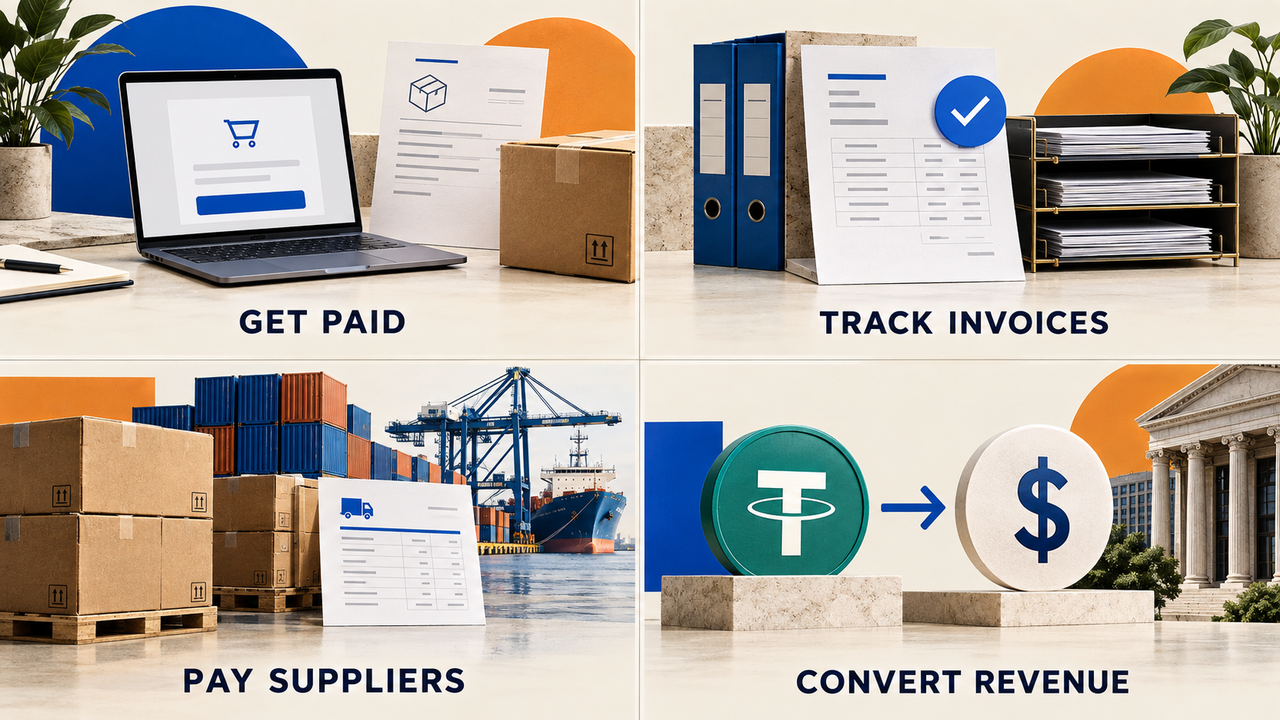
1.Accept payments from global B2B clients
A software provider can give an overseas client a crypto payment option at checkout or create an order-specific request through an API. For a client who tops up a service balance repeatedly, a permanent deposit address can be tied to that client’s account.
When the payment is confirmed, the provider can update the right account and release the service. The value of crypto payments for businesses is practical here: the team knows who paid and which account to update.
2. Request and track B2B invoice payments
For a one-off project or milestone, a CCPayment Invoice gives the client a structured payment request with the amount and available payment options. Finance can track its status in the Invoice Dashboard. Businesses that need automated system updates can instead create an order through the Payment API and process the corresponding webhook notification.
The invoice reference makes reconciliation easier when several clients pay on the same day. The business should also make the accepted network and its handling of late or partial payments clear before the client sends funds.
3. Crypto payments for suppliers and business partners
An agency might pay one overseas contractor at the end of a project and dozens of affiliates at the end of a month. A single network withdrawal can suit an individual supplier payment, while the Batch Withdrawal API can handle approved payments to multiple contractors, affiliates, or partners. The team can prepare those payments once recipients have agreed on the asset and network.
Before sending, finance should check the wallet address, coin, network, amount, and internal approval. A supplier who invoices in USD to a bank account needs a suitable fiat route instead.
4. Convert crypto revenue for business operations
Crypto receipts may eventually pay rent, payroll, or suppliers that expect bank funds. A company can convert eligible coins into USDT, then request USD settlement when needed. The conversion and the bank transfer are separate transactions, each with its own costs and processing steps.
The Bank for International Settlements notes that properly designed and regulated stablecoin arrangements may address some cross-border payment frictions, while also raising regulatory, financial-integrity, and monetary-policy considerations.
How a B2B Crypto Payment Workflow Works
Here is one monthly service payment from collection to payout:
- Request: Send an invoice link or create a payment order with the supported coin and network.
- Confirm: Treat the webhook as a notification, verify its signature, and query the corresponding payment record before updating the client’s invoice.
- Manage: Hold the received coin or, if configured and supported, convert it into a stablecoin balance.
- Reconcile: Compare the invoice, amount received, fees, and transaction record.
- Pay: Withdraw crypto to an approved contractor wallet or request eligible USDT-to-USD bank settlement.
Blockchain confirmation and bank credit happen at different times. USD settlement also depends on review, the banking route, and the recipient. Tell counterparties which stage has been completed.
What Should Businesses Look for in a B2B Crypto Payment Solution?
Follow one client invoice through to a supplier payment when comparing business crypto payment solutions:
- Get paid: Can clients pay by invoice, API order, or permanent address? Will you know which client paid?
- Manage currency: Are clients’ coins and networks supported? Can receipts be converted into USDT?
- Pay out: Can finance approve single or batch supplier payments?
- Reconcile: Can records connect receipts, fees, and payouts?
- Reach a bank account: Can supported incoming assets be converted into USDT, and what rates and fees apply?
Compare the cost of that full route, including conversion, network fees, and bank settlement.
How CCPayment Supports B2B Crypto Payment Workflows
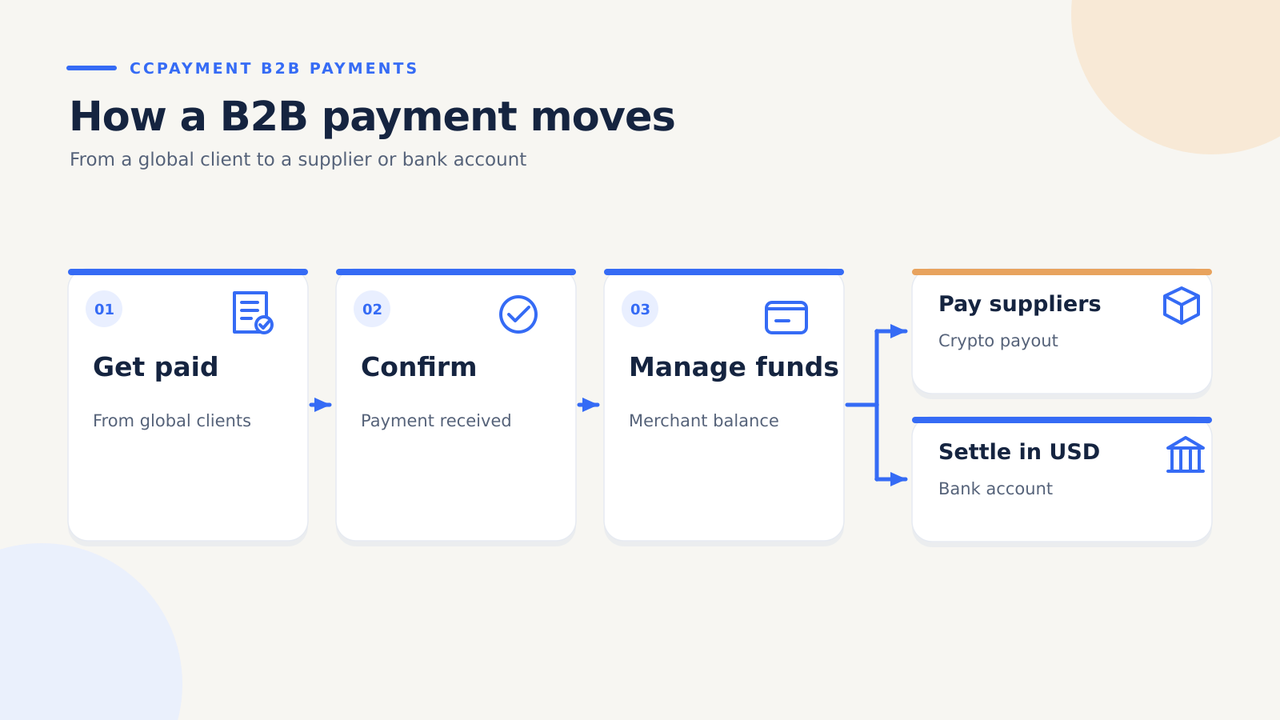
Take an exporter that invoices a buyer and needs to pay a supplier. With CCPayment, it can send the buyer a Dashboard Invoice and track the payment from the Invoice records. If automated reconciliation is required, it can create an order through the Payment API, receive a webhook notification, and verify the corresponding payment record before updating the invoice in its own system.Once the payment reaches Success and is not flagged as risky, the funds are credited to the merchant balance.
The exporter can use CCPayment’s Auto-Swap feature to convert supported incoming coins into USDT. It can pay the supplier in crypto; If the supplier prefers USD, it can request USDT-to-USD settlement and track the bank transfer in the dashboard.
Plan your integration with the CCPayment API Documentation, explore its e-commerce and SaaS workflows, or create a merchant account to get started.
Crypto Adoption for Business 2026
Deep dives into Web3 payments, industry trends, and how to scale your global commerce with zero-code integrations.
FAQ
Q1: Can businesses use crypto for international invoice payments?
A: Yes, when the payer and recipient agree on the asset and network. An invoice link can make the payment details easier to present and connect the resulting transaction to a specific bill.
Q2: Can a business pay suppliers in crypto?
A: Yes, if the supplier accepts a supported asset and provides the correct receiving details. The business should verify those details and follow its payout approval process.
Q3: Does accepting crypto mean holding volatile coins?
A: No. Businesses can choose supported stablecoins as payment assets or use available conversion settings for eligible incoming coins. Conversion terms and fees should be reviewed separately.
Q4: How does a business receive USD after collecting USDT?
A: With CCPayment, merchants can request USD settlement from their USDT balance in the dashboard. Choose an eligible bank recipient and track the request there—no API integration needed. In faster cases, USD can reach the receiving bank within two to three business days, subject to review and banking routes.