Why Cross-Border Payments Fail and How Crypto Fix Them
⏱️ TL;DR: This guide shows how to use status-machine idempotency, multi-chain reconciliation, and stablecoin settlement to prevent dropped transactions and double-spending at scale.
Why cross-border crypto payments fail at scale
Here's what nobody says in the pitch deck: most payment failures in high-volume crypto operations aren't blockchain problems. They're architecture problems.
Ghost Transaction Hell
The scenario plays out like this:
"The payment confirmed on-chain. The customer sent the money. But the order never moved."
This is a ghost transaction. It happens when the payment reaches the blockchain, but the notification never reaches your application.
This isn't a blockchain failure—it's a data pipeline failure. With 500 daily transactions, it's a bad week. At 10,000 daily transactions, it's a structural crisis.
The three failure modes:
| Failure Mode | What Happens | Merchant Impact |
| Wrong-chain send | Customer reuses an EVM address across Ethereum and BSC. Funds land on a chain your system isn't monitoring. | Deposit never detected. Order expires. |
| Missing Memo/Tag | XRP or Cosmos-based chains require a destination tag. It's absent. | Funds received but unmatched to any order. |
| Dead webhook endpoint | Your server was down for 11 minutes during a deploy. The payment event fires and goes unanswered. | Order expires. Customer emails support. |
In 2026, this is not an edge case. McKinsey tracked cross-border B2B stablecoin payments growing 733% year-over-year to $226 billion. The volume is real. The failures compound with it.
The Scale Multiplier
At 100 transactions a day, one ghost transaction is a five-minute manual fix. At 10,000 a day, a 3% failure rate means 300 unfulfilled orders every 24 hours. At that volume, manual reconciliation is no longer a process—it's a hiring plan.
The root cause is rarely the blockchain. It's the architecture that sits between the chain and the application. When that architecture treats payment notifications as best-effort messages rather than guaranteed deliveries, scale turns a small gap into a systemic failure.
Three architecture failures: wrong-chain, missing metadata, webhook loss
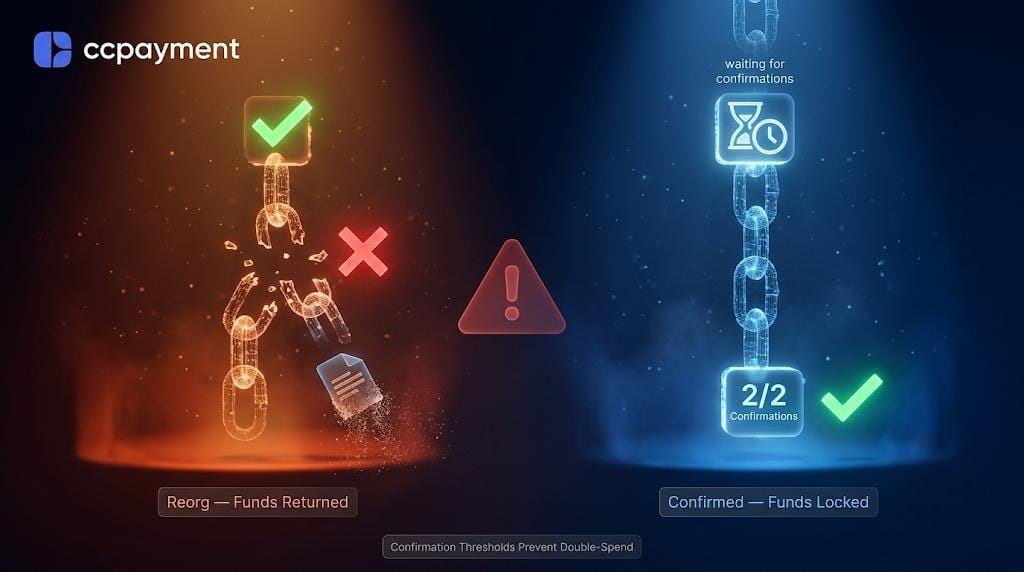
The Real Risk: Transaction Rollbacks
When a transaction appears on-chain, it can still be undone. There are two ways this happens:
Unconfirmed transaction replacement (RBF)
A sender increases the gas fee to replace a pending transaction before it's included in a block. The original transaction is discarded.
Confirmed transaction reversal (Reorg)
A blockchain reorganization occurs when the network temporarily forks and the shorter chain is abandoned. Transactions on that chain are wiped from the ledger—the funds effectively return to the sender.
If a platform credits users too early, before a transaction reaches the required confirmation threshold, it increases the risk of crediting funds that are not yet final.
In practice, this can create reconciliation issues and potential loss exposure if the transaction is later replaced or invalidated.
The safer approach is to credit only after the transaction is treated as final under the network and platform’s policy.
The Fix: Confirmation Thresholds
CCPayment prevents this with coin-specific confirmation requirements. Once a transaction meets required block confirmations, CCPayment scans it into the system and fires a webhook:
Merchant-Side Protection: Idempotency
CCPayment will retry webhook delivery if your server doesn’t respond successfully. But the same webhook may arrive more than once.
Simple fix: On every incoming webhook, use the TxID as your idempotent key—check your database before processing. If it exists, skip. If it's new, credit and record.
CCPayment prevents double-spends at the blockchain level. Your code prevents double credits at the application level. Both are required.
How to prevent double credits with confirmation + idempotency
CCPayment Webhooks Don't Go Missing
Your webhook endpoint was unreachable for 22 minutes during a Tuesday evening deploy. Four transactions reached Success during that window. CCPayment retried each one. Your server came back online, returned the correct response, and the retries stopped. No notification was lost.
Here's how it works: If CCPayment doesn't receive HTTP 200 with "Success" in the response body, it tries again—up to 6 times over roughly an hour. Once a valid response is received, retries stop.
The Verification Step: Get Deposit Record API Endpoint
The webhook tells you a payment has occurred. The API confirms exactly what happened.
Don't assume a confirmed payment means the balance should update automatically. The correct flow:
Webhook received
       ↓
Call getDepositRecord API
       ↓
Retrieve: amount,asset,timestamp,tx hash etc.
       ↓
Your server applies credits to user balance
CCPayment monitors the chain and delivers deposit data. The accounting logic is yours. This separation keeps audit trails clean and gives you full control over when and how credits are applied.
Volatility Defense: Why stablecoin settlement matters for treasury
The Token Volatility Bleed
Accepting volatile tokens like ETH or BTC exposes your revenue to instant price drops. The time gap between an on-chain broadcast and block finality is a risk zone. If network congestion delays block confirmation by just 15 minutes during a market dip, a 5% price drop can wipe out your profit margin before the funds reach your wallet. Without an automated conversion layer, your team is forced to absorb constant price slippage and unpredictable asset drawdowns.
The Stablecoin-First Standard
The market has already shifted to avoid this risk. Chainalysis reports that adjusted stablecoin transaction volume has reached $28 trillion in genuine economic activity. B2B clients increasingly prefer stablecoins. Restricting checkouts to USDT or USDC completely eliminates asset volatility by design.
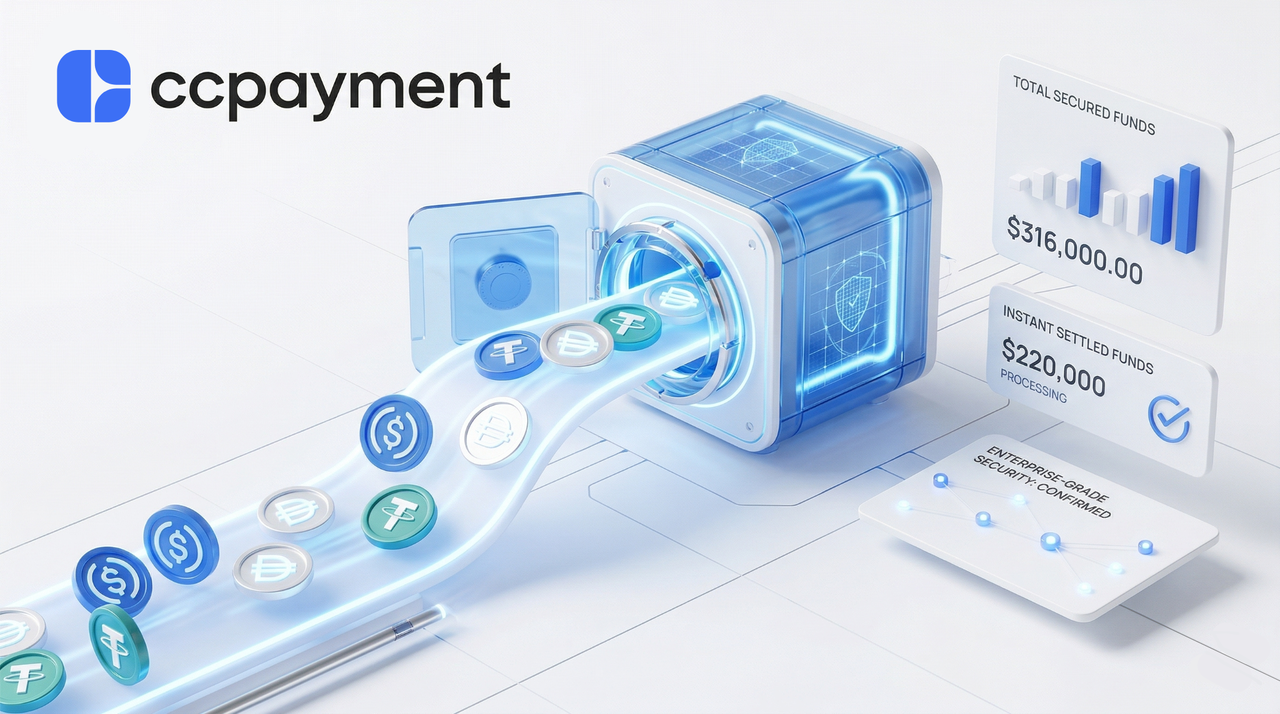
Stablecoin Settlement
To help merchants manage volatility while keeping checkout options flexible, CCPayment offers treasury features designed around stablecoin settlement.
- Real-Time Auto-Swap: After a selected token reaches the required confirmation threshold, CCPayment can convert the received value into USDT or USDC. This helps merchants reduce exposure to short-term market swings.
- Fiat Off-Ramp to Bank: Merchants can also convert stablecoin balances into fiat for bank settlement, with timing dependent on banking rails, compliance checks, and the receiving bank’s processing cycle.
- No Rolling Reserve Requirement: Compared with many traditional payment processors that may hold reserves to manage dispute risk, CCPayment is designed to support faster access to funds and more efficient working capital usage.
What enterprise merchants should ask a gateway before integrating
Payment Generation Layer
- Generate all addresses server-side via API — never expose API keys client-side
- Use permanent addresses per user for recurring payments, dynamic addresses per order for one-time checkouts
- Lock exchange rates at invoice creation with a 10–30 minute validity window
- Log every address generation event with user ID and timestamp
Webhook Processing Layer
- On receipt: return
200 OKwith"Success"in the body immediately → push to async queue - Validate HMAC signature on every inbound request — reject anything unsigned
- Use
TxIDas idempotent key — query before processing, skip if already recorded - Trigger business logic only on
Successstatus —Pendingis not fulfillment signal - Call
getDepositRecordAPI to retrieve full deposit details before crediting any account
Settlement and Compliance Layer
- Prioritize USDT/USDC, or enable Auto-Swap for volatile-asset acceptance
- Enable KYT screening — outsource compliance cost, don't rebuild it internally
- Confirm zero rolling reserve in your gateway contract before signing
CCPayment: the Reliable Foundation
| Pain Point | CCPayment Solution |
| Ghost Transactions | Permanent addresses + multi-chain monitoring |
| Race Condition / Double Credit | Native webhook retry + merchant-side idempotency support |
| Deposit Verification | getDepositRecord API — full accounting control stays with merchant |
| FX Volatility | Optional Auto-Swap (0.6%) + stablecoin-first settlement |
| Capital Lock-Up | Zero Rolling Reserve — funds available on settlement |
| Compliance Overhead | SlowMist KYT + AML screening built in |
| Integration Complexity | Unified API across 45+ currencies and chains |
CCPayment is the unified Web3 payment infrastructure for global business—built for high-volume merchants that need enterprise-grade reliability, not a checkout plugin. It handles the blockchain nodes, the webhook retry logic, the compliance screening, and the multi-chain complexity. You handle your product.
👉 [Create Your CCPayment Account and Start with a 0.2% Rate Today]
FAQ
Q: What's the practical difference between permanent addresses and dynamic addresses in a scalable checkout API?
A: The practical difference lies in their lifecycle and deposit rules:
- Permanent Addresses: These are generated once per user and remain active indefinitely. Users can deposit any amount at any time, and the funds go directly into your merchant balance. (Note: For the same user, all EVM-compatible chains share the exact same address).
- Dynamic Addresses (Order-bound): These are one-time use addresses tied to a specific checkout order. They require a fixed deposit amount to complete the transaction.
CCPayment supports both via our API; use permanent addresses for flexible account funding, and dynamic addresses for strict single-order checkouts.
Q: How do I actually test idempotency control before deploying to production?
A: In your staging environment, replay the same webhook payload twice in rapid succession. Verify that exactly one credit is applied. If your handler processes both, your deduplication logic has a gap. Common culprits: database write not completing before the second event hits, or the TxID check running outside a transaction lock.
Q: Does CCPayment Auto-Swap work across all chains, or only specific networks?
A: Auto-Swap operates at the token level rather than the chain level. You simply choose which tokens to convert via your dashboard. Once enabled, deposits for your selected tokens will automatically swap into your preferred stablecoin, regardless of the originating chain.
Crypto Adoption for Business 2026
Deep dives into Web3 payments, industry trends, and how to scale your global commerce with zero-code integrations.