Why Businesses Accept Monero (XMR) Payments in 2026
⏱️ TL;DR: Public blockchains expose your B2B supply chain to competitors. Monero (XMR) closes this gap with default protocol-level privacy. Discover the business case for XMR, regulatory trade-offs, and how to integrate it without running your own node.

The Public Blockchain Problem Nobody Talks About in B2B
Most businesses don't think about payment privacy until it costs them something.
When you pay a supplier in Bitcoin or USDC, that transaction is public. Permanently. Any competitor, analytics firm, or data broker with your wallet address can audit your payment history — how often you pay, how much, and to whom. For a coffee shop, that's uninteresting. For a cross-border seller managing 40 suppliers across Southeast Asia, or an iGaming platform processing high-value player settlements, that's a competitive risk that sits on-chain forever.
A competitor with a block explorer and your wallet address can map your entire supply chain in an afternoon. A SaaS platform's transaction frequency and volumes become a live revenue dashboard for rivals. Privacy-conscious customers — the ones who subscribe to VPN services, buy from privacy-first platforms, or transact in iGaming — specifically avoid payment methods that create a traceable financial record.
Payment Method | Sender Visible? | Receiver Visible? | Amount Visible? |
Bank Wire / Credit Card | Yes (to bank) | Yes (to bank) | Yes (to bank) |
Bitcoin / Ethereum / USDC | Yes (publicly) | Yes (publicly) | Yes (publicly) |
Monero (XMR) | No | No | No |
Monero was built to close all of these gaps at the protocol level. Its privacy is enforced by default on every transaction — not as an optional setting you toggle on, as with some competing chains. Sender, receiver, and amount are all hidden. No opt-in step. No configuration. If the payment arrives, it's private.
This isn't about ideology. It's about a specific business problem: some customer segments want to pay without broadcasting their purchase history, and some businesses want to receive revenue without broadcasting their cash flow to competitors. For those transactions, Monero is the pragmatic default.
Four Reasons to Accept XMR: What Monero Actually Does Differently
1. Payment Privacy at the Protocol Level
Monero uses three cryptographic mechanisms on every transaction. What matters for business isn't the cryptography — it's what each layer protects.
Technology | What It Hides | Business Outcome |
|---|---|---|
Ring Signatures | Who sent the payment | No one can prove a transaction originated from your wallet |
Stealth Addresses | Who received it | Your collection address never appears on-chain; each payment creates a fresh one-time address |
RingCT | How much was sent | Transaction amounts are verified by the network but invisible to outside observers |
The result: a confirmed XMR payment has no traceable sender, no visible recipient address, and no disclosed amount. All three are enforced by default. A competitor with your wallet address gains nothing. Every XMR coin is also fully fungible — there's no such thing as a "tainted" coin with a flagged history, which matters for businesses that need clean, uncomplicated settlement.
2. No Intermediary, No Freeze Risk
Traditional payment rails run through banks and processors. Those intermediaries can freeze accounts, flag transactions, or simply decline to process payments — usually without warning. XMR transactions are peer-to-peer, confirmed on-chain by miners rather than approved by a financial institution. There's no account to freeze, no intermediary to satisfy, and no chargeback mechanism for customers to reverse a payment after receiving goods.
For cross-border sellers, freelancer platforms paying contractors in emerging markets, or businesses in industries that banks have historically treated as high-risk, this is the point that matters most. Once a Monero transaction is confirmed, it's final.
3. Low-Cost, Fast Global Settlement
XMR's average transaction fee sits around $0.20, regardless of destination. The World Bank's most recent data puts the average bank wire fee at 6.36% globally. Settlement is typically confirmed within minutes. For businesses running international supplier payments or contractor payouts on a weekly cycle, that speed difference compounds quickly.
4. Reaching the Segment That Actively Avoids Transparent Payments
Some customers are privacy-conscious by design. VPN subscribers. iGaming participants. High-net-worth individuals who manage their financial footprint deliberately. These users know exactly what a public blockchain reveals about them. If your checkout doesn't offer a genuinely private payment option, a portion of this segment will leave rather than compromise. Adding XMR isn't about being crypto-forward — it's about removing a friction point for customers who have a specific, well-defined preference.
Who's Actually Using XMR Payments — and For What
Monero acceptance isn't evenly distributed. The strongest commercial adoption clusters in a few predictable verticals.
Digital service providers — VPNs, VPS hosting, security tools.
The customer base here already self-selects for privacy awareness. Several VPN providers have publicly stated that Monero payments now account for a disproportionate share of their subscription revenue — a signal that privacy-conscious users vote with their wallets when given the option.
iGaming and entertainment platforms.
Online entertainment platforms and gaming businesses serve privacy-conscious users. Monero provides this without requiring the platform to operate outside compliance. The merchant's on-chain activity is private, not illegal.
Cross-border B2B supplier payments.
A growing number of cross-border sellers pay overseas manufacturers and logistics partners in XMR specifically to prevent competitors from mapping supply chains via on-chain analysis. The payment settles fast, fees are low, and the flow is invisible to anyone outside the transaction.
Freelancer and creator platforms.
Independent contractors in markets with capital controls or unstable banking increasingly prefer XMR payouts over stablecoin transfers that leave a fully auditable financial record. Platforms that offer XMR as a payout option reduce friction for this segment without adding operational complexity.
What You Should Know Before Adding XMR
Monero isn't for every business. Here's what to weigh before integrating.
Liquidity has shifted, not disappeared.
Trading has moved to decentralized exchanges and P2P markets. Conversion to USDT or fiat is still available but requires an extra step compared to top-five coins. Regulatory treatment of privacy-focused assets varies by jurisdiction. If you operate a regulated financial entity within the EU, adding XMR requires legal review. Outside the EU, most jurisdictions permit it — but check your specific territory.
The network proved resilient despite the delistings.
Roughly 9.1 million transactions settled on Monero over the trailing year, per LocalMonero data, even as regulatory pressure increased. That resilience signals organic demand from committed users — not speculative volume that evaporates when market sentiment shifts.
Not a fit for every business model.
If you need daily fiat conversion through compliant institutional channels, or if your primary market is EU-regulated financial services, XMR adds complexity without proportionate benefit. The businesses that add XMR successfully are the ones where customer base and business model align with the coin's value proposition. The realistic take: for most merchants, a stablecoin-first stack with an optional XMR collection — converted at receipt via a gateway's swap function — is the more practical architecture.
How to Accept Monero Payments with CCPayment
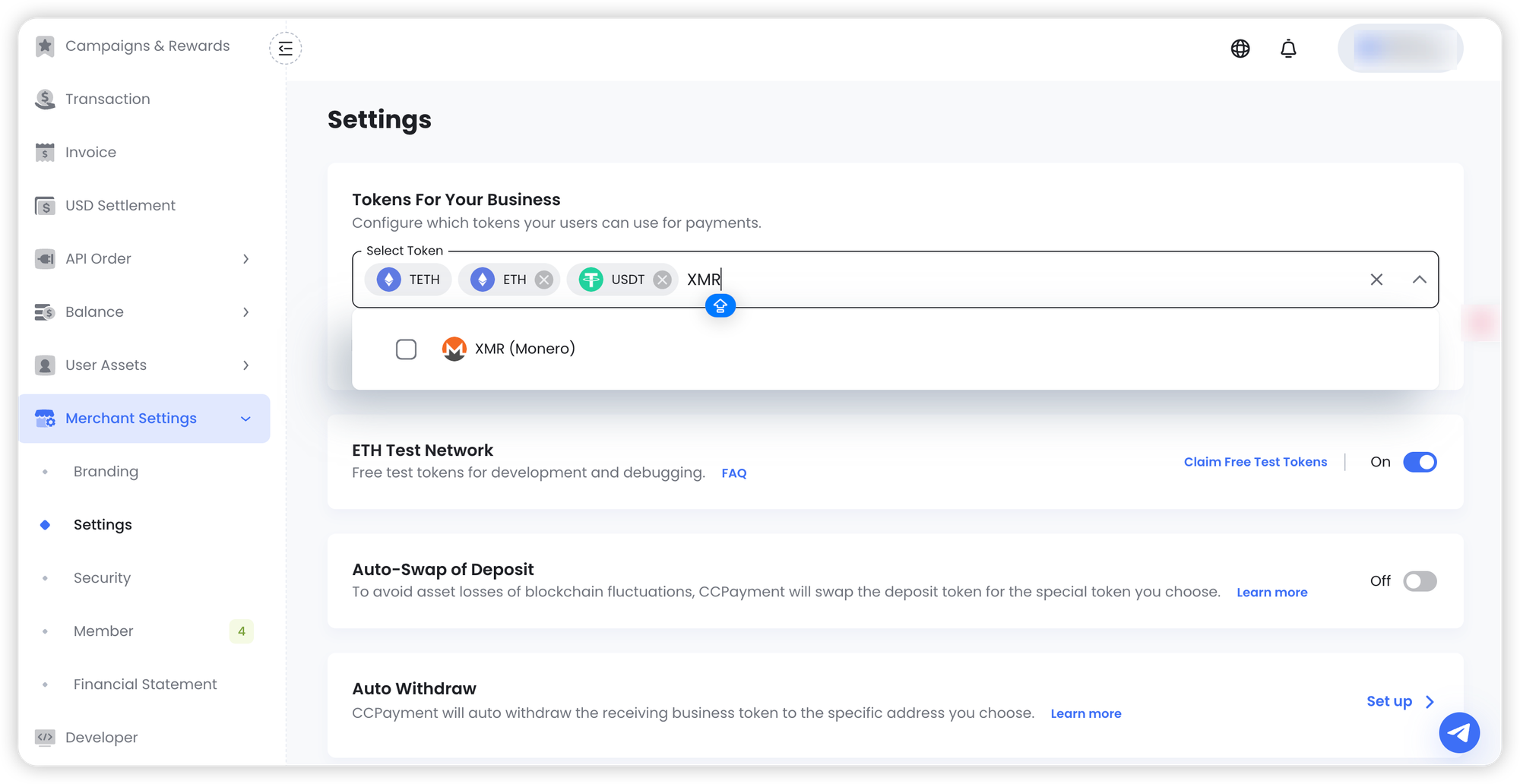
Integrating Monero does not require complex development cycles or dedicated hardware infrastructure. With CCPayment, you simply enable XMR in your dashboard under Merchant Settings → Tokens for your business.
Once activated, Monero instantly appears alongside your other supported assets at checkout. There is no separate code to deploy, no self-hosted Monero node to run, and no custom webhook handling required. The exact same unified API, single dashboard, and centralized reconciliation workflow manage everything seamlessly. CCPayment supports over 900 cryptocurrencies through a single integration.
👉 Accept Monero payments with CCPayment
FAQ
Q1: Should my business accept Monero payments?
A: If your customers value privacy or prefer private checkout options, XMR can be a strong addition to your payment mix. CCPayment lets you enable Monero natively, so you can expand payment options without rebuilding your existing crypto payment setup. Always confirm the fit with your internal compliance and legal team for your operating market.
Q2: Which businesses can benefit most from Monero payments?
A: Monero is often a good fit for privacy-focused digital services, iGaming platforms, and cross-border businesses that want a more discreet payment option for customers or partners. If your audience already asks for privacy-friendly payments, adding XMR can help reduce checkout friction and capture demand you might otherwise miss.
Q3: Why do some businesses add Monero?
A: Businesses usually add XMR when they see a clear customer need, especially in segments where privacy matters at checkout. For the right business, XMR can unlock an additional payment option, improve conversion for privacy-sensitive users, and help you stand out from competitors that only offer mainstream coins.
Q4: Do I need a separate integration to accept Monero on CCPayment?
A: No. You can enable XMR directly in your CCPayment Dashboard under Merchant Settings → Tokens for your business. Once turned on, XMR works within your existing unified API and reconciliation flow, so you can expand your payment options without adding extra development work. CCPayment also supports 900+ cryptocurrencies through a single integration.
Crypto Adoption for Business 2026
Deep dives into Web3 payments, industry trends, and how to scale your global commerce with zero-code integrations.