iGaming Crypto Payments Case Study: How a Large Merchant Built a Compliant Stablecoin Rail
⏱️ TL;DR: CCPayment helped multiple iGaming merchants process multimillion-dollar deposit flows during the World Cup period, unify multi-chain payments under one integration, and isolate risky funds before they reached merchant treasuries.

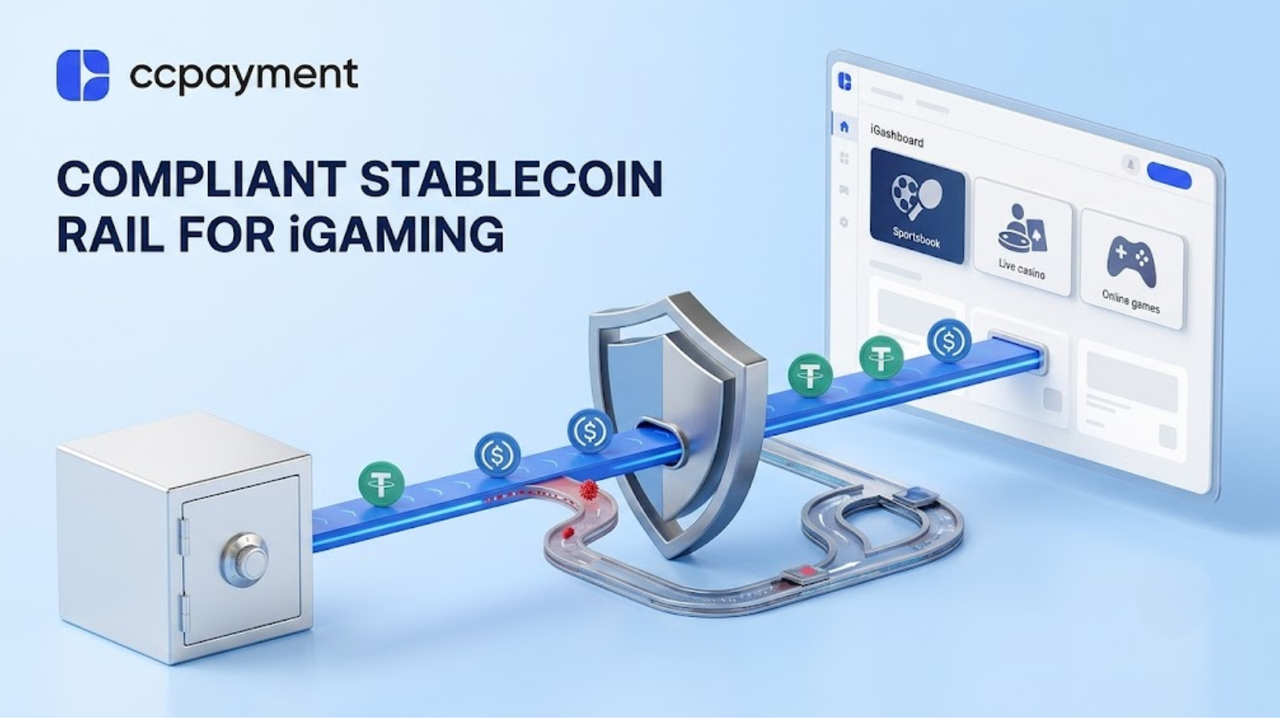
Stablecoins have become a practical payment method for iGaming, but building them into an operational system at scale is the real challenge. This need is bringing compliant stablecoin rails into the core payment stack. McKinsey and Artemis estimate that stablecoin payments reached $390 billion in 2025, including $226 billion in B2B activity—evidence of their growing role in commercial settlement.
For one large diversified iGaming platform, the objective was to unify multi-chain acquiring, KYT controls, treasury management, payouts, and transaction data under one operating model.
Executive Snapshot
Over a three-and-a-half-year partnership, CCPayment helped a diversified iGaming operator support multimillion-dollar deposit flows during peak periods, including the World Cup cycle. The compliant stablecoin rail unified multi-chain acquiring, KYT-driven risk isolation, treasury management, batch payouts, and audit-ready transaction data in one operating model.
Rather than splitting payments and treasury across disconnected systems, the operator used CCPayment to keep clean revenue moving while isolating risky incoming funds before they reached the main treasury.
| Partnership | Crypto Payment Volume | Permanent Deposit Addresses | Incoming Funds | Recorded Transactions |
| 3.5 Years | USD 10M+ Monthly | 1M+ Addresses | 1% Risk Isolated | ~98% Success |
The Merchant: A High-Volume iGaming Platform Managing Multi-Chain Payments
The operator runs a comprehensive online gaming platform serving a large base of iGaming and gambling users. Permanent deposit addresses are central to its payment model: each address is linked to an internal reference ID, allowing future deposits to be matched to the same account without a new order.
At this scale, the merchant needed an iGaming crypto payment gateway that could support a large address base, multiple assets and networks, fast payment recognition, risk-aware crediting, and reliable reconciliation without splitting the operation across disconnected systems.
Before the Rail: Where High Volume Increased Cost and Complexity
At enterprise scale, every wallet, network, player account, and payout adds another record for operations and finance teams to manage.
Too Many Chains Increased Cost and Complexity
Players do not all use the same stablecoin network. Separate payment logic for every asset-network combination increases integration work and makes reconciliation and deposit investigations harder.
Risky Funds Increased Treasury Exposure
Crypto payments reduce conventional card chargeback exposure while introducing source-of-funds risk. A confirmed payment may still have links to illicit activity, sanctioned entities, stolen funds, or high-risk address clusters. Once it reaches the main treasury, that exposure can affect later transfers to an exchange, custodian, bank, or other counterparty.
Chainalysis estimates that illicit activity represented less than 1% of attributed crypto transaction volume in 2025. At the same time, stablecoins accounted for 84% of illicit crypto transaction volume. Even a small share of questionable funds can create disproportionate treasury exposure.
Player experience and payment recognition
iGaming deposits are time-sensitive. Players expect balances to update quickly, while operators need clear payment, network, amount, status, and risk data.
Audit and reconciliation pressure
Manual blockchain lookups do not scale. Operators across the EU and UK, Latin America—including Brazil and Mexico—and Southeast Asia need consistent identifiers and retrievable records for reconciliation and local compliance reviews.
The Solution: Building the Stablecoin Rail in Four Layers
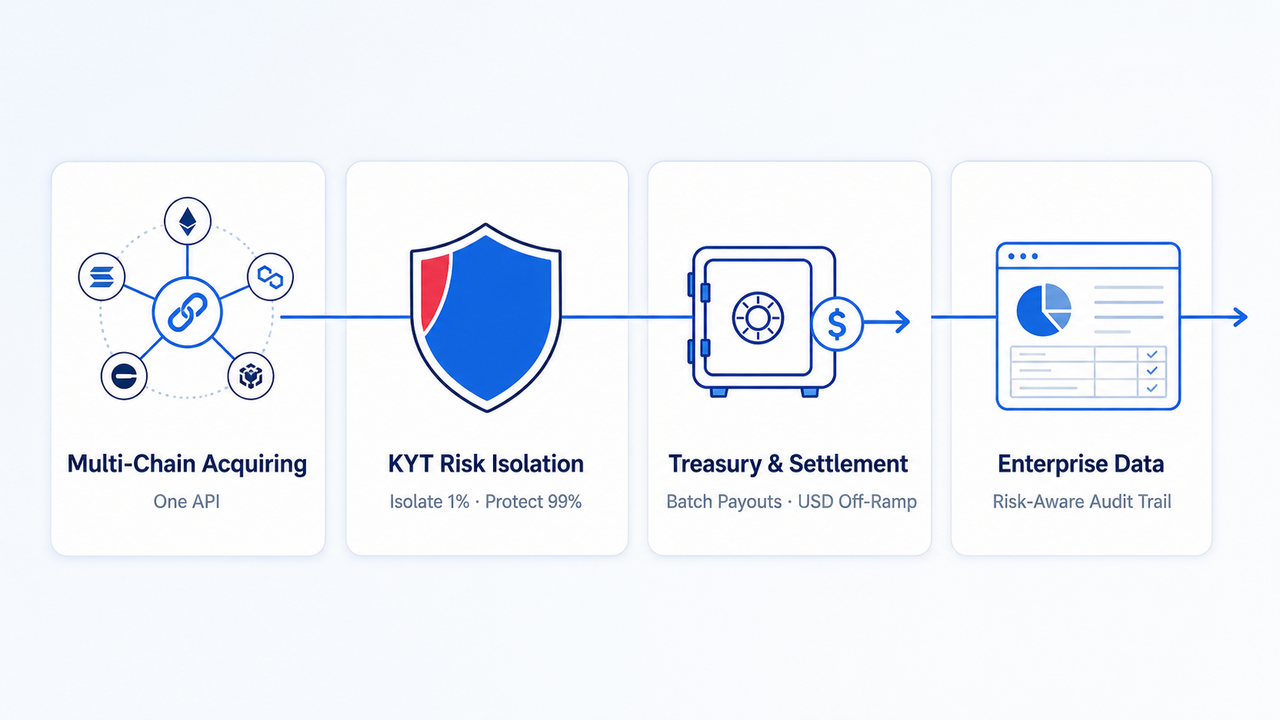
The rail was built around four connected capabilities: multi-chain acquiring, KYT-driven risk isolation, clean treasury operations, and enterprise-grade transaction data.
One Integration for Multi-Chain Acquiring
CCPayment supports more than 900 cryptocurrencies across over 100 blockchain networks. Through one API connection, the merchant can enable the assets and networks relevant to its player base and control which options appear in the payment flow.
Permanent addresses link recurring deposits to a player reference. For fixed requests, the merchant can generate an order-based address or use a hosted flow in which the player chooses from enabled assets and networks. The selected payment request is then routed to the correct asset-network combination through the same integration.
Webhooks report status changes, while order queries and scheduled reconciliation provide additional verification before a player is credited, including when a callback is delayed. Players retain network choice while the operator manages one acquiring layer.
KYT-Driven Risk Isolation
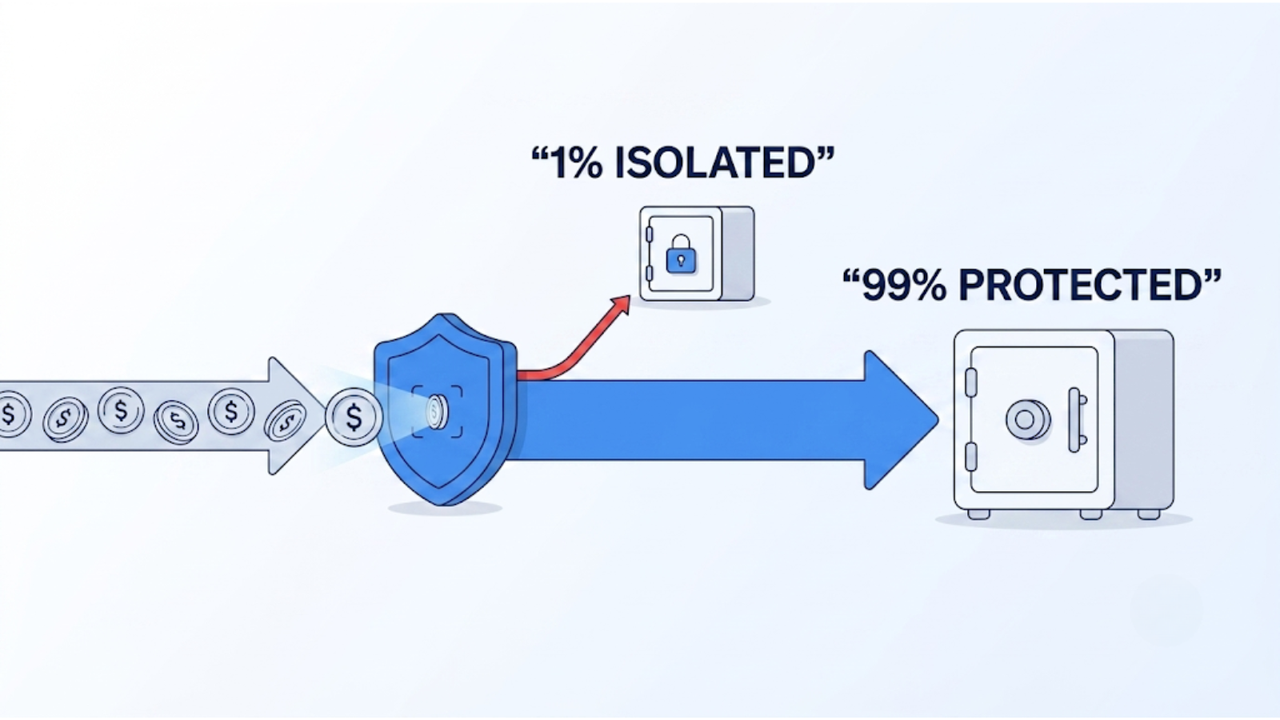
Approximately 1% of incoming funds were identified as risky.
The isFlaggedAsRisky field allows normal transactions to continue through the standard crediting logic. Flagged transactions appear separately under Risky Transactions and stay outside the available balance.
he operator can refund risky funds to the original sender. Batch workflows let teams process flagged funds by coin or receiving address. This makes early risk isolation a practical part of crypto compliance for gaming.
Simpler Treasury Management, USD Off-Ramping, and Batch Payouts
Separating normal and flagged deposits gives the merchant a clearer base for stablecoin treasury management. Successful deposits enter the available balance, while risky transactions remain in a separate review, refund, or dedicated-wallet workflow.
Automated batch payout for iGaming helps operators process large withdrawal queues, with pre-transfer checks for invalid addresses, missing memos, and blacklisted destinations.
For merchants that require fiat settlement, CCPayment also offers an optional USD off-ramp. Operators reporting in other currencies can still use the transaction records for internal reconciliation, while fiat settlement is currently available in USD.
Enterprise-Grade, Risk-Aware Transaction Data
Transaction data can include the merchant’s referenceId, CCPayment recordId, coin information, status, and risk flag. The operator can use this risk-aware transaction metadata to connect each payment with its own player, order, GEO, KYC, and behavioral records, creating a clearer reconciliation and audit trail.
Partnership That Reduced Cost and Complexity
What began as a payment integration evolved into a long-term operating partnership. As the merchant’s monthly volume increased, it benefited from CCPayment’s volume-based pricing structure, helping keep transaction costs efficient at scale.
At the same time, merchant feedback directly informed product development. CCPayment expanded deposit-record APIs, introduced batch filtering by referenceId and orderId, raised record limits, and added TRX energy rental support to better support high-volume operations.
During CCPayment’s World Cup deposit-reward campaign, the merchant reached the highest cumulative reward level and received the full 1,810 USDT available. Separate referral programs have also allowed long-standing merchants to earn a 15% share of the platform’s net fees generated by referred standard-rate merchants.
That combination of commercial flexibility and product iteration is what makes the partnership durable at enterprise scale.
Results: Lower Cost, Faster Settlement, Better Control
After three and a half years, the rail continues to operate at scale. Approximately 98% of recorded transactions reached a successful status. On commonly used networks, deposits could be recognized within seconds, with most reflected within about one minute, subject to blockchain conditions.
Risk screening flagged roughly 1% of incoming funds for additional handling, and those funds were returned for customer-side review, while the remaining 99% continued through the normal balance and reconciliation process.
Operations had fewer disconnected payment paths to manage. Finance gained a clearer view of available and flagged funds, while compliance gained a repeatable process for handling risky transactions before they entered the main treasury flow. The merchant maintained this flow without recurring payment or compliance-related complaints.
Figures reflect CCPayment’s internal platform records and have been rounded to preserve commercial confidentiality.
What Other iGaming Operators Can Take From This Case
Stablecoins can reduce dependence on banking hours and conventional card chargebacks. At scale, every payment still needs to be traceable, linked to the correct player, and screened before entering the main treasury.
For payment leaders, CFOs, AML directors, and operations teams evaluating compliant stablecoin rails, the practical playbook is straightforward:
- Design for multiple networks. Player preferences change, and a single-chain strategy can become another payment silo.
- Assign a stable reference to every player or order. Fast deposits still need accurate reconciliation.
- Screen risk before balance availability. Define when flagged funds should be refunded.
- Connect payment and merchant data. The operator retains control of KYC, GEO, and responsible-gaming records.
- Choose infrastructure that can evolve. Networks, pricing, reconciliation, and support needs change with volume.
CCPayment supports this model through multi-chain acquiring, permanent player addresses, KYT-driven risk isolation, batch payouts, transaction metadata, and optional USD settlement. Its compliance framework includes U.S. and Canadian Money Services Business registrations and an Australian Remittance Service Provider license. Merchants remain responsible for local gaming, AML, and customer-verification obligations.
For large gaming operators, a mature crypto payment strategy combines fast player transactions with clear control over risk, treasury, and payment data.
Request a Stablecoin Rail Assessment
If your current payment setup is spread across wallets, networks, or providers, share your monthly payment volume, required assets and networks, deposit model, payout workflow, and USD settlement needs with CCPayment.
You will receive a tailored assessment covering the recommended integration structure, KYT risk-control workflow, treasury and batch-payout model, and volume-based pricing for your operation.
Request an integration assessment or explore the CCPayment API documentation.
FAQ
Q1: Why should iGaming operators add stablecoin payments?
A: Stablecoins give international players a fast way to deposit outside banking hours. They can reduce dependence on card channels, support faster payment recognition, and open another payment route in markets where crypto is permitted.
Q2: Can CCPayment support high-volume iGaming payments across multiple networks?
A: Yes. One API supports more than 900 cryptocurrencies across over 100 networks. Operators can enable the options relevant to their players while managing status, reconciliation, and risk handling within the same infrastructure.
Q3: How do permanent deposit addresses improve the player experience?
A: A permanent address lets returning players deposit without creating a new order each time. It stays linked to the merchant’s player reference, reducing payment steps and reconciliation work.
Q4: How does CCPayment help iGaming businesses scale payment operations?
A: CCPayment combines multi-chain acquiring, KYT risk isolation, treasury management, batch payouts, and transaction data. High-volume merchants can also access volume-based pricing and optional USD settlement based on their requirements.
Crypto Adoption for Business 2026
Deep dives into Web3 payments, industry trends, and how to scale your global commerce with zero-code integrations.