Why Tokenized Assets Need Better Payment Rails for Global Commerce
⏱️ TL;DR: CCPayment connects tokenized RWAs to corporate banks with multi-chain rails, KYT controls, and automated treasury.

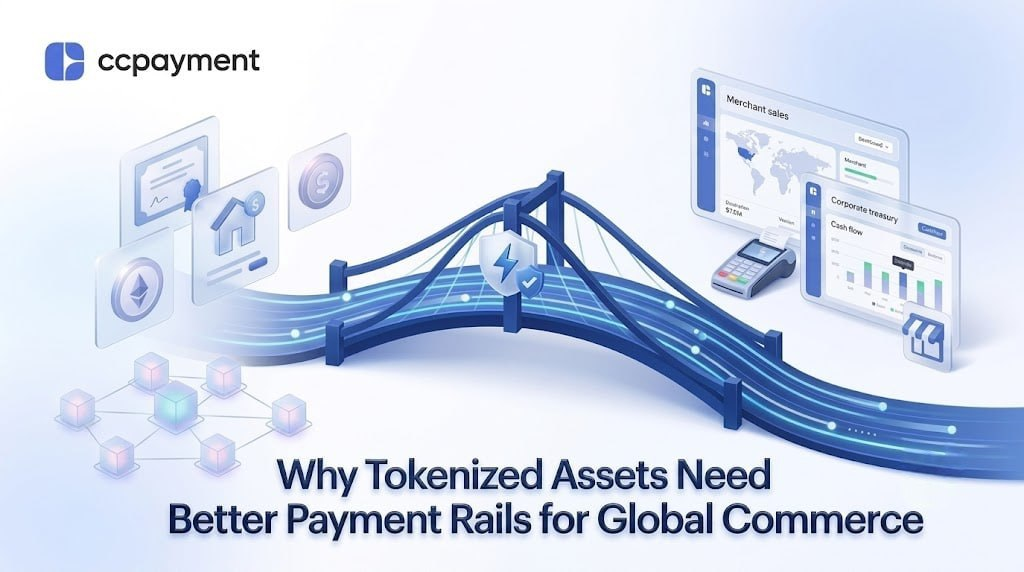
Tokenized assets are no longer a whitepaper category.
On July 1, 2026, Robinhood Markets has launched the public mainnet of Robinhood Chain, a Layer 2 blockchain that the company said is purpose-built for real-world assets.. The chain quickly attracted significant trading activity, with early data pointing to substantial DEX volume that briefly ranked it among the top blockchain networks. As decentralized finance ecosystems mature with projects like Pons Launchpad building on dedicated L2 chains, liquidity is heavily decentralizing across digital assets, tokenized equities, and yield-bearing stablecoins.
The problem isn't asset supply. It's that most merchant payment infrastructure was built for card rails and bank wires—not programmable assets, multi-chain settlement, or the reconciliation model that on-chain commerce actually requires.
What Is Tokenized Commerce?
Tokenization is fundamentally changing commercial settlement. Global buyers, SaaS clients, cross-border platforms, and autonomous AI agents now hold wealth on-chain. When users hold stock tokens, tokenized treasury bills, or stablecoins on high-speed Layer 2 networks, they expect to spend that liquidity directly.This is not a fringe retail trend. Data from McKinsey estimates that stablecoin payment volume reached $390 billion in 2025, with $226 billion driven by B2B commercial settlement.The payment method your customer uses is no longer just a currency. It's a programmable on-chain asset. Yet, when these holders attempt to purchase software, fund digital services, or settle high-value transactions, enterprise merchants hit a wall. Accepting a tokenized payment is simple; building a compliant, scalable engine that converts on-chain liquidity into a clean treasury balance without operational drag is where legacy systems collapse.
Why Traditional Payment Rails Fail
Traditional acquiring networks were built for centralized, fiat-denominated card networks. When a merchant tries to process tokenized asset payments through a traditional payment stack, legacy rails fail across four specific operational friction points:
| Friction Area | Legacy Payment Rail Reality | Impact on Enterprise Merchants |
| Settlement Speed | T+3 to T+7 rolling reserves, delayed bank sweeps | Severe working capital drag and constrained treasury liquidity. |
| FX & Slippage Costs | Mandatory conversion from crypto to fiat at high spreads | 2% to 4% margin erosion from hidden conversion fees. |
| Financial Reconciliation | Isolated wallet records disconnected from ERPs | Manual ledger entries, accounting bottlenecks, and audit risk. |
| Off-Ramp Bottlenecks | Banks flagging incoming crypto-origin funds | Risk of frozen corporate accounts due to unverified source-of-funds. |
A stablecoin transaction settles on-chain in minutes. A traditional processor that batches settlements at end-of-day means the merchant waits 24–72 hours to access funds the blockchain finalized 20 minutes ago. Worse, processors often run incoming funds through an internal conversion engine before the merchant sees them, taking a 0.5%–1.5% spread. For a business processing $2 million monthly in on-chain payments, a 1% spread is $20,000 per month in pure margin loss.
What Tokenized Commerce Actually Needs
To capture on-chain volume without compromising security or treasury operations, enterprise CFOs and VPs of Payments require three non-negotiable infrastructure components.
1.Institutional KYT and Segregated Funds Handling
Accepting multi-chain crypto payments eliminates credit card chargeback risk, but introduces source-of-funds risk. According to Chainalysis , while illicit activity accounted for less than 1% of total crypto transaction volume in 2025, stablecoins represented 84% of that illicit volume. Infrastructure must screen every inbound transaction, produce an auditable record at the payment level, and flag high-risk on-chain exposure before it reaches the merchant balance.
2. Native Settlement & Compliant Off-Ramp Routes
Native settlement means the asset that arrives is the asset that stays, until the merchant decides to convert. No forced round-trip through the processor's internal exchange. When fiat liquidity is required, the rail must provide a compliant, documented, and direct route to corporate bank accounts in USD, supported by appropriate licenses.
3. Automated Treasury & Programmatic Reconciliation
Finance teams processing tokenized payments across multiple chains and customer segments need a reconciliation layer that works programmatically—not a monthly CSV export. Systems require permanent address mapping, programmatic batch payouts for vendor settlements, and audit-ready transaction metadata (like referenceId, recordId, txId) that feeds directly into enterprise financial software.
How CCPayment Supports Tokenized Commerce
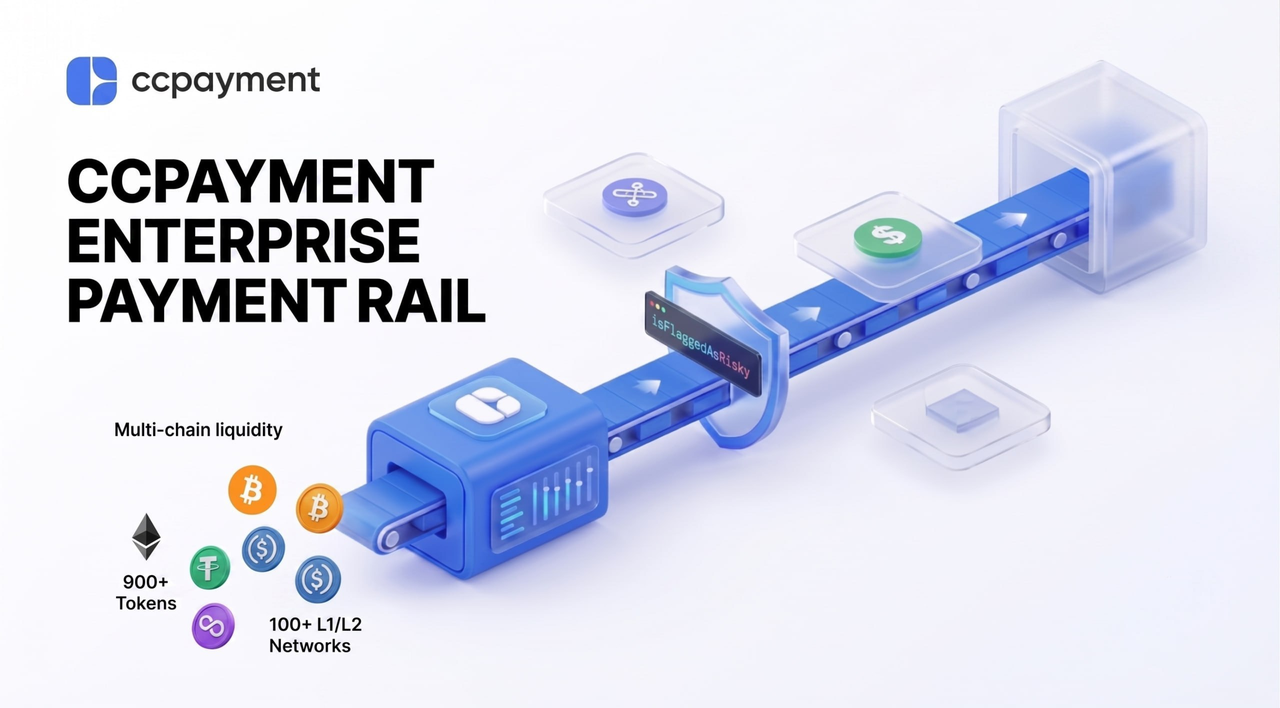
CCPayment is built for this transition, not as a simple checkout widget, but as an enterprise-grade payment infrastructure layer that connects multi-chain liquidity directly to a corporate balance sheet.
- Unified Multi-Chain Acquiring
Rather than maintaining separate integrations for every blockchain, CCPayment normalizes inflows across 900+ cryptocurrencies and 100+ L1/L2 networks into a single API. Merchants can assign static, permanent deposit addresses to recurring buyers or generate dynamic invoices, managing all asset flows in one system. - Automated KYT Risk Screening
CCPayment screens eligible inbound transactions through third-party AML and KYT providers before they become available to merchants. Transactions that pass the applicable screening rules may be credited in near real time, while transactions flagged as high risk through theisFlaggedAsRiskyAPI field are separated from the merchant’s available balance and routed for compliance review. This helps limit the exposure of the merchant’s operating balance and automated fiat settlement flow to potentially high-risk funds. - Compliant USD Off-Ramping
Merchants configure settlement per currency: hold the original token, convert via optional Auto-Swap, or route to a verified USD corporate bank account through CCPayment's fiat off-ramp channel. Operations are backed by robust regulatory compliance frameworks, including U.S. and Canadian Money Services Business (MSB) registrations. - Batch Payouts & Programmable Execution
For businesses disbursing funds to global vendors, creators, or affiliate networks, the Batch Withdrawal API handles up to 500 recipients per run. The system runs automated pre-transfer checks—intercepting invalid formats and blacklisted addresses before funds move on-chain.
Why This Matters for Global Merchants
Transitioning from legacy payment gateways to an enterprise-grade crypto rail yields immediate operational benefits:
- Eliminate Rolling Reserves: Access capital instantly without T+7 holding periods.
- Remove FX Friction: Settle in native stablecoins to preserve core profit margins.
- Protect Corporate Banking Relationships: Real-time KYT isolation keeps unverified or high-risk funds out of primary corporate bank accounts.
- Scale Without Operational Headcount: Automated batch disbursements and unified webhooks convert a manual accounting bottleneck into a clean data flow.
Tokenized assets and stablecoins are reshaping how global commerce settles. Merchants running on outdated PSP rails risk losing market share to competitors offering frictionless, multi-chain payment options.👉 Planning to accept multi-chain payments at scale? Request a CCPayment Integration Assessment to review your payment volume, supported networks, payout workflows, KYT requirements, and USD settlement options.
FAQ
Q1: How does CCPayment help manage high-risk crypto deposits?
A: CCPayment applies transaction-level AML and KYT screening before eligible deposits become available to merchants. Deposits that are not flagged by the applicable screening rules may be credited in near real time, while deposits flagged as high risk through the isFlaggedAsRisky API field are excluded from the merchant’s available balance and routed for compliance review. This helps limit the exposure of the merchant’s operating balance and automated fiat settlement flow to potentially high-risk funds.
Q2: Can we accept payments on Layer 2 networks and settle directly into USD?
A: Yes. CCPayment supports major L1 and L2 networks (including Ethereum, Polygon, Arbitrum, BNB Chain, Solana, and emerging L2s). Merchants can hold funds as native stablecoins or utilize our compliant USD off-ramp to disburse funds directly to their corporate bank accounts.
Q3: How does CCPayment handle batch payouts for international suppliers or vendors?
A: Through our Batch Payout API, you can execute up to 500 sub-orders per master batch request. The platform automatically validates payout addresses, checks required memos, and screens for blacklisted destinations prior to submission, significantly reducing manual administrative work and transaction failure rates.
Q4: Is this infrastructure relevant if we only accept stablecoins, not exotic tokens or RWAs?
A: Absolutely. For stablecoin-only operations, the core value lies in KYT screening on inflows, native settlement without forced FX conversion spreads, a compliant fiat off-ramp, and API-native reconciliation. Multi-chain and multi-token support is an additional capability, not a prerequisite for utilizing enterprise payment infrastructure.
Q5: How do AI agent payments work for merchant settlement?
A: AI agents are fully programmatic payers—they call APIs, monitor payment status via webhook, and trigger fulfillment without human action. The exact same CCPayment infrastructure that handles consumer checkout handles autonomous agent micropayments. The key requirement is idempotency-safe webhook handling, which our enterprise APIs natively provide.
Crypto Adoption for Business 2026
Deep dives into Web3 payments, industry trends, and how to scale your global commerce with zero-code integrations.