Most Reliable Crypto Payment Gateways for Merchants in 2026
⏱️ TL;DR: Reliability in crypto payments means uptime, low fees, and effortless reconciliation. We compare 6 leading gateways in 2026 across fees, asset coverage, and APIs—and why CCPayment ranks #1 for enterprise merchants.

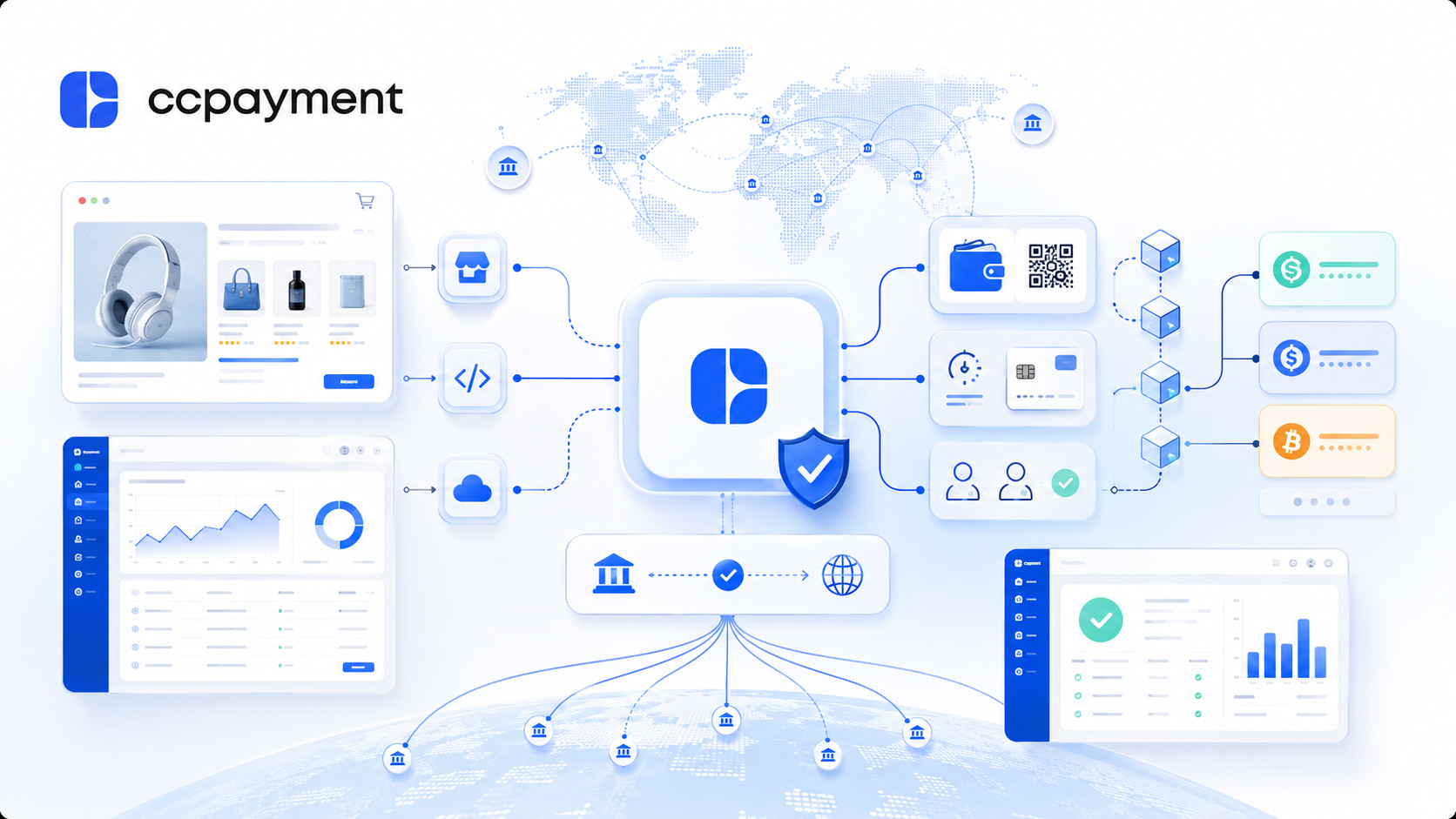
A merchant-focused comparison of fees, crypto coverage, settlement options, and operational reliability
For a merchant, the most reliable crypto payment gateway is not necessarily the one with the longest coin list. Reliability is operational: the checkout must stay available, payment notifications must arrive correctly, finance teams must be able to reconcile balances, and funds must remain accessible when the business needs them.
This guide compares six options for payment, product, operations, finance, and compliance teams. Based on the criteria below, CCPayment ranks #1 for merchants that prioritize broad native crypto acceptance, low volume-based fees, flexible account models, and API-led payment infrastructure.
Editorial disclosure: Rankings are an editorial assessment based on the methodology below, not an award or certification from an independent third party. Product availability, fees, and eligibility can change; confirm commercial terms and supported jurisdictions directly with each provider.
Ideal merchant profile
| Gateway | Fees | Crypto coverage | Settlement | Best for |
| #1 CCPayment | 0.2%-0.5% | 900+ assets / 100+ networks | Crypto; USD off-ramp | Global SaaS, gaming & Web3 platforms |
| #2 NOWPayments | 0.5%–1% | 350+ assets | Crypto; fiat via partners | E-commerce & altcoin payments |
| #3 CoinGate | 1% / custom enterprise | 10+ assets | Crypto, stablecoins & fiat | EU merchants & e-commerce |
| #4 BitPay | 1%–2% + $0.25 | 100+ assets | Crypto & fiat | Mid-market & enterprise |
| #5 Coinbase Business | Account-specific* | Primarily USDC-focused with select stablecoins and networks | USDC or USD | US & Singapore businesses |
| #6 Stripe | 1.50% | Select stablecoins (USDC and others, region-dependent) | Local currency | Existing Stripe businesses |
Migrating Coinbase Commerce merchants retain 1% pricing; other Coinbase Business merchants can view current fees after signing in.
How we evaluated reliability
We evaluated information a buyer can verify before launch.
Payment continuity and transaction integrity
Uptime matters across the entire payment path: checkout creation, address generation, blockchain monitoring, webhooks, dashboard access, and withdrawals. Enterprise buyers should also evaluate incident history, recovery objectives, and service-level commitments.
Settlement and treasury control
“Fast settlement” can mean several things. The customer’s transfer may appear quickly, become spendable after network confirmations, or reach a bank account days later. This review separates on-chain availability from fiat off-ramping. Finance teams should examine supported settlement assets, minimum payout thresholds, payout schedules, conversion spreads, banking coverage, and the ability to export a complete ledger.
API integration and operational tooling
A reliable API integration needs more than a create-payment endpoint. We looked for hosted checkout, webhooks, documentation, SDKs, plugins, reconciliation data, wallet or account models, and support for testing.
Security and compliance readiness
Licenses and registrations are jurisdiction- and activity-specific, not universal approvals. A merchant must confirm which legal entity provides its service and whether its authorization covers the proposed product and country.
Support and escalation
“24/7 support” is not the same as a contractual response time. Buyers should assess channel availability, technical expertise, account management, and escalation targets for payment-critical incidents.
Pricing transparency
The lowest payment gateway fees are the lowest total cost—not simply the smallest headline percentage. Total cost can include the gateway fee, network fee, conversion fee, and settlement or off-ramp fee. We also considered setup, subscription, and minimum charges.These criteria focus on what happens after checkout, when payment status, reconciliation, settlement, and support become critical.
How a reliable crypto payment gateway works
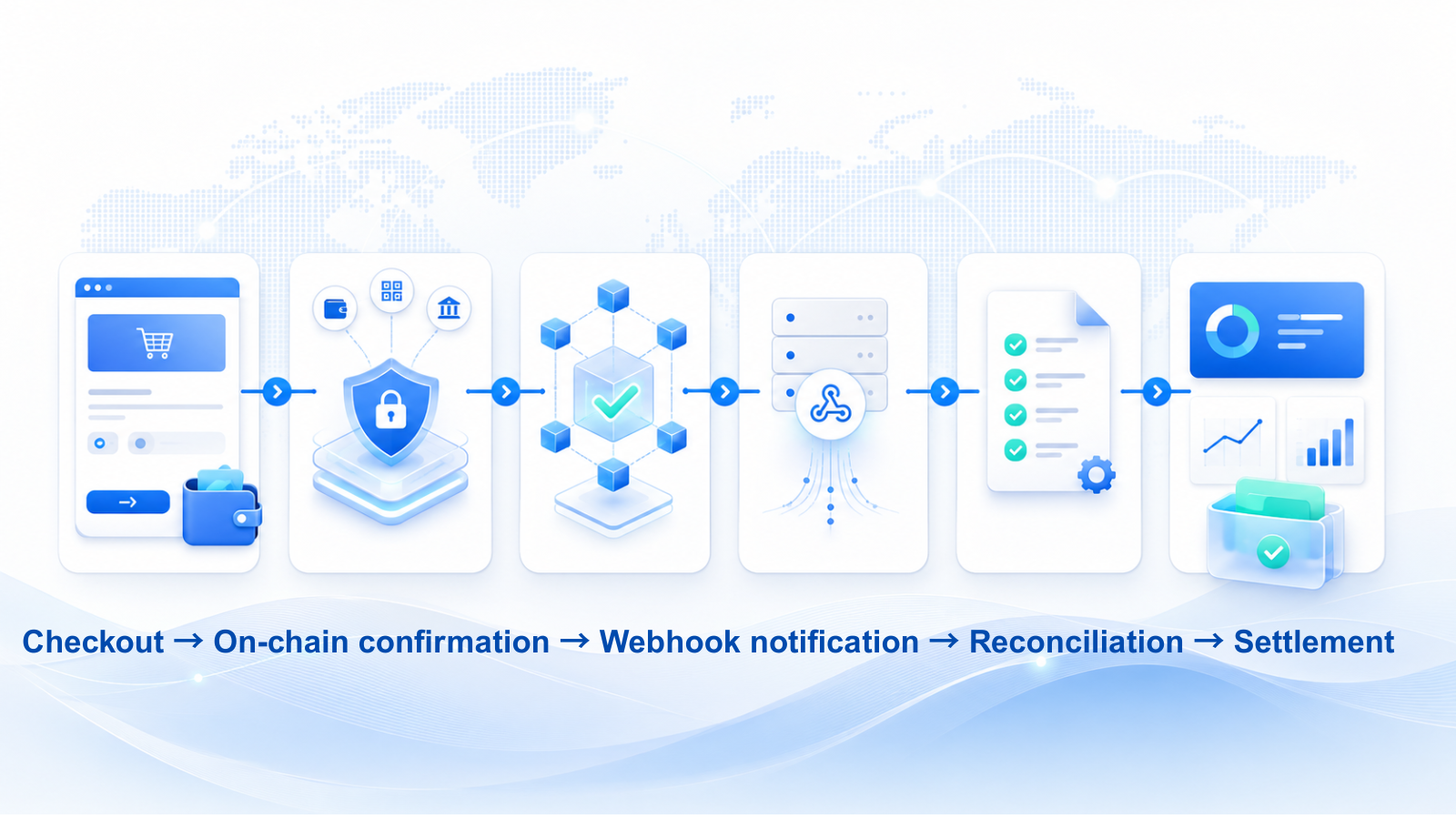
At checkout, the gateway creates a payment address or hosted session, monitors the blockchain, and sends a webhook to update the order. After confirmation, the merchant can retain the asset, convert it, withdraw on-chain, or use fiat settlement. Reliability depends on the full path from payment detection to reconciliation and access to funds.
CCPayment supports this flow through one-time Retail Checkout addresses, reusable Permanent Addresses, real-time notifications, automated reconciliation, and Wallet Mode for user-level balances. This gives merchants a choice of payment architecture instead of forcing every business into the same checkout model.
1.CCPayment: best overall for merchants needing broad crypto acceptance and API-led operations
Best for: Cross-border e-commerce, SaaS, gaming, Web3, and wallet-based platforms.Key strengths: CCPayment combines checkout, treasury, and wallet infrastructure. It supports 900+ cryptocurrencies across 100+ networks, including USDT, USDC, and XMR. Merchants can receive high-demand and long-tail assets without forcing every payment through automatic conversion.Three operating modes support different business models:
- Retail Checkout Mode: One-time addresses and order-level reconciliation for e-commerce.
- Permanent Address Mode: Reusable customer addresses for memberships, subscriptions, and repeat deposits.
- Wallet Mode: User-level balances and internal transfers for wallet, trading, and digital platforms.

- Operational reliability: CCPayment supports 24/7 crypto payment operations with round-the-clock assistance through Telegram and Intercom. Real-time notifications reduce missed paid orders, while automated reconciliation connects on-chain payments with merchant records. Dashboard and withdrawal controls help operations and finance teams manage funds across time zones.
- Security and compliance: CCPayment maintains US and Canadian Money Services Business registrations and an Australian remittance service provider license. Controls include KYT monitoring, NIST-aligned encryption, double-key encryption, and multifactor authentication.
- Pricing / fees: Volume-based deposit fees start as low as 0.2%, with no setup fee, monthly subscription, or hidden maintenance fee. Crypto withdrawals have no CCPayment service fee; only the network fee applies. Optional USD off-ramping is priced separately at 2.49% plus 49.75 USDT, with a 2,000 USDT minimum and typical processing time of 3–7 days.
- Asset support: 900+ cryptocurrencies and 100+ networks, including USDT, USDC, and XMR.
- Integration: REST API, webhooks, SDKs, hosted checkout, payment links, WooCommerce, and AI-assisted integration. Additional tools include auto-withdrawal, stablecoin conversion, payroll payments, and crypto-to-fiat functionality. See the official website and API documentation.
- Verdict: Based on this methodology, CCPayment is the strongest all-around choice for merchants seeking low processing costs, native multi-asset acceptance, and infrastructure that extends beyond checkout. Its advantage is clearest for businesses that need permanent addresses and user balance.
2.NOWPayments: best for merchants prioritizing asset breadth
- Best for: Online businesses that want wide asset support, common e-commerce plugins, and optional automatic conversion without building extensive wallet infrastructure.
- Key strengths: NOWPayments advertises 350+ cryptocurrencies, fiat conversion, and 24/7 support. Its catalog includes an API, invoices, subscriptions, point of sale, plugins, widgets, and white-label options.
- Limitations: Automatic conversion can add cost or reduce control over the settlement asset. Merchants comparing a NOWPayments alternative should request an all-in quote rather than compare only the 0.5% starting commission.
- Pricing / fees: Payments without conversion cost 0.5% plus the network fee. Autoconverted or fixed-rate payments cost 1% plus the network fee; 0.5 percentage points of that rate represent the swap fee. Off-chain conversion is 0.5%. Withdrawals and mass payouts have no service fee, although network fees apply.
- Asset support: More than 350 cryptocurrencies are advertised on the NOWPayments website, including stablecoins.
- Integration: API, plugins, invoices, subscription tools, widgets, buttons, QR point of sale, and white-label solutions.
- Verdict: NOWPayments is a capable broad-market gateway and one of the closest comparisons to CCPayment. Choose it when its plugin and conversion ecosystem matches the business; favor CCPayment when lower volume-based processing, permanent-address or wallet modes, and broader advertised asset coverage are decisive.
3.CoinGate: best for EU-oriented merchants
- Best for: European merchants that want a regulated provider, a straightforward standard price, instant conversion, and settlement into EUR, stablecoins, or crypto.
- Key strengths: CoinGate states that it is MiCA-licensed in the EU and available in 180+ countries. Its standard plan clearly publishes 1% processing, no monthly fee, weekly automatic settlement, and payout and conversion charges.
- Limitations: CoinGate’s current pricing page describes acceptance of 10+ cryptocurrencies, materially fewer than the broad catalogs promoted by CCPayment and NOWPayments. Standard-plan email support and weekly automatic settlement may not meet every high-volume merchant’s requirements, although enterprise terms provide dedicated technical support and custom rates.
- Pricing / fees: CoinGate’s official pricing lists a 1% standard processing fee. Crypto payouts cost €0.50 + 0.5%; payouts with conversion cost €0.50 + 1.5%; manual currency exchange is 1%; and SWIFT withdrawal is 0.5% with a €50 minimum fee. Enterprise pricing is customized.
- Asset support: 10+ accepted cryptocurrencies, with settlement into EUR, stablecoins, or crypto; availability varies by asset, network, and region.
- Integration: API, hosted checkout, payment links, dashboard invoicing, and e-commerce plugins.
- Verdict: CoinGate is attractive when European regulatory positioning and fiat settlement outweigh the need for hundreds of accepted assets. It is less suitable for merchants whose conversion economics or long-tail coin demand are central.
4.BitPay: best for established merchant teams
- Best for: Larger retailers and recognizable brands that value a long operating history, curated asset support, settlement tooling, and established business controls.
- Key strengths: BitPay offers online and in-store payments, billing, payouts, major cryptocurrencies and stablecoins, plugins, API access, and fiat settlement.
- Limitations: Its curated asset list is less suitable for long-tail tokens or XMR, and smaller merchants pay more than with low-fee crypto-native gateways.
- Pricing/fees: BitPay pricing ranges from 2% + $0.25 below $500,000 in monthly volume to 1% + $0.25 at $1 million or more.
- Integration: API, hosted invoices, e-commerce integrations, in-store tools, and payouts.
- Verdict: Best suited to established mid-market and enterprise merchants that prioritize brand familiarity and fiat operations.
5.Coinbase Business: best for stablecoin-focused businesses
- Best for: Eligible US and Singapore businesses that want payments, trading, custody, invoicing, and accounting workflows within one recognizable ecosystem.
- Key strengths: Coinbase Business combines payment links, invoices, payouts, APIs, trading, custody, compliance controls, and accounting integrations. It also provides a public Commerce status page.
- Limitations: The Coinbase Business page currently limits onboarding to the United States and Singapore, while asset availability is region-dependent.
- Pricing/fees: Coinbase Onchain Payments charges 1%. Confirm current terms during onboarding because other Coinbase product costs may differ.
- Integration: APIs, payment links, invoices, payouts, and accounting integrations.
- Verdict: Most compelling for eligible businesses already using Coinbase for treasury and operations.
6.Stripe stablecoin payments: best for businesses extending an existing Stripe stack
- Best for: Businesses in supported markets that already use Stripe and want stablecoin checkout while continuing to settle and reconcile in fiat.
- Key strengths: Stablecoin payments integrate with Stripe Checkout, Payment Links, Elements, Billing, and the Payment Intents API. Completed payments settle into the merchant’s Stripe balance in local currency, simplifying reconciliation and treasury management.
- Limitations: Stripe is a stablecoin payment option rather than a broad crypto gateway. It supports USDC across five networks, while USDP and USDG are available only to US businesses. Merchant availability is also region-dependent, and stablecoin payments have a maximum transaction value of $10,000. Businesses that need BTC, ETH, USDT, XMR, or broader asset coverage will need another provider.Pricing/fees: Stripe charges 1.5% of the transaction amount in USD for stablecoin payments. Check Stripe’s current pricing for country- and contract-specific terms.
- Integration: Payment Links, Checkout, Elements, Payment Intents API, and existing Stripe reporting.
- Verdict: A low-friction choice for eligible businesses already on Stripe, but narrower in geography and asset scope than a dedicated crypto gateway.
Which gateway should your business choose?
There is no universal winner in crypto payments. The right gateway depends on your operating model, not brand recognition alone.
Choose CCPayment if your priorities include low volume-based fees, broad native asset support, 100+ networks, permanent customer addresses, wallet balances, or API-led treasury workflows.
Compare total processing costs, monthly volume, required assets, supported networks, and settlement preferences before deciding. For teams evaluating a global, API-first stack, CCPayment is a strong fit for merchants that treat crypto as payment infrastructure rather than an extra checkout option.
Explore CCPayment’s merchant infrastructure or review the API documentation to validate the setup for your business.developers.
FAQ
Q1: Which crypto payment gateway is most reliable for merchants?
A: CCPayment is a strong option for merchants that want low fees, broad crypto support, and flexible integration. It works well for global businesses that need API-first payments and optional USD settlement. Compare your expected volume, supported assets, and payout needs before choosing a gateway.
Q2: Which crypto payment gateway supports USDT, USDC, and XMR?
A: CCPayment supports USDT, USDC, XMR, and 900+ cryptocurrencies across 100+ networks. This makes it a strong fit for merchants who want to accept stablecoins and a wider range of native crypto assets from global customers. Check whether your business needs wallet-based payments, fixed addresses, or hosted checkout.
Q3: What fees do crypto payment gateways charge?
A: Crypto payment gateway fees usually include processing fees, network fees, and possible conversion costs. CCPayment starts at 0.2% and does not charge setup fees, monthly subscriptions, or platform withdrawal fees. The best choice depends on your monthly volume, settlement model, and asset mix.
Q4: Can merchants settle crypto payments in USD?
A: Yes, CCPayment supports optional USD settlement through merchant off-ramping. This is useful for businesses that want to accept crypto while keeping treasury operations in fiat. You can review the settlement flow based on your transaction size and business needs.
Q5: How can a business integrate CCPayment?
A: Businesses can integrate CCPayment through REST API, webhooks, SDKs, hosted checkout, payment links, WooCommerce, or AI-assisted integration. Retail Checkout, Permanent Address, and Wallet modes serve different business models.
Crypto Adoption for Business 2026
Deep dives into Web3 payments, industry trends, and how to scale your global commerce with zero-code integrations.