How Crypto Payment Gateways Can Support Cross-Border Ecommerce
⏱️ TL;DR:Crypto payment gateways enable 24/7 cross-border payments without card-network chargebacks. CCPayment supports order-based checkout, 900+ cryptocurrencies, stablecoin conversion, reconciliation, and optional USD settlement.

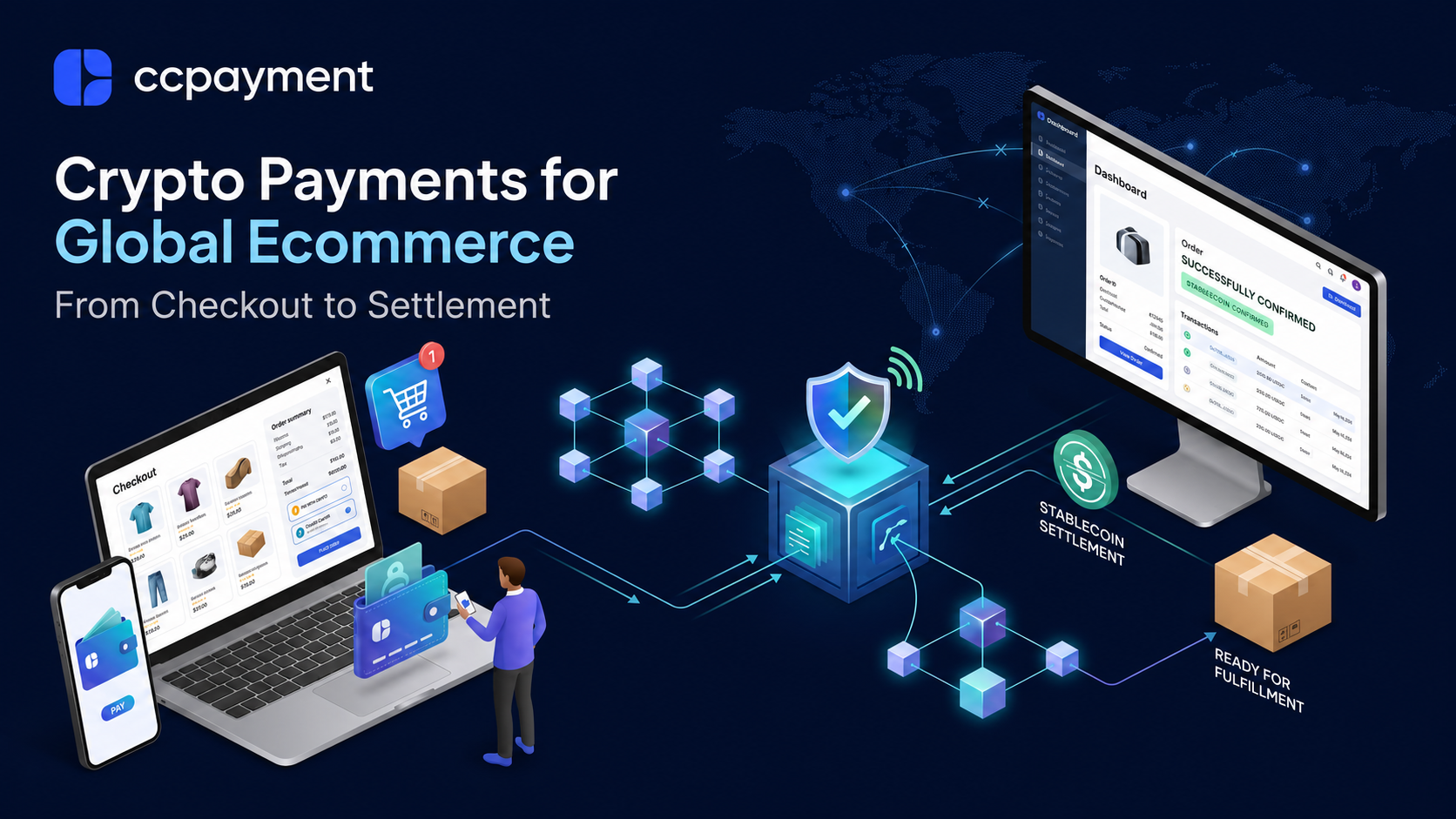
A store can sell into dozens of countries, yet its payment stack may still depend on local card acceptance, banking hours, FX conversion, and dispute rules. As order volume grows, these limitations affect margins and working capital—not just checkout conversion.
A crypto payment gateway for ecommerce adds an always-on payment rail for customers who prefer cryptocurrencies or stablecoins. It can complement cards and local methods without requiring merchants to build a separate banking connection for every market.
The Hidden Cost of Selling Across Borders
Cross-border checkout is rarely consistent. A method that performs well in one country may be unavailable or frequently declined in another, causing customers to leave before completing their orders.
The amount paid is also not necessarily the amount received. Processing charges, intermediary deductions, currency conversion, and FX spreads reduce margins. Convera's overview of cross-border payment challenges identifies hidden FX costs, limited transparency, regulatory complexity, and slow delivery as continuing concerns.
An order may be completed on Friday while the funds remain unavailable until the following week. A Federal Reserve analysis explains that long intermediary chains can add costs, delay delivery, and make payments harder to track.Friendly fraud makes revenue less predictable: customers may dispute legitimate purchases after shipment, leaving merchants with the product loss and dispute costs.
What Do Cross-Border Ecommerce Payment Fees Really Include?
The advertised rate is only one part of the cost. Finance teams should examine three layers:
- Visible transaction costs: Payment processing and cross-border transaction fees.
- Conversion costs: Currency conversion charges and FX spreads between the customer payment and merchant settlement currencies.
- Operational costs: Settlement delays, rolling reserves, disputes, refunds, and the staff time required for reconciliation.
A competitive headline rate does not always produce the lowest total payment cost.
From Wallet Transfers to Order-Level Payment Infrastructure
These cost pressures are one reason some cross-border merchants are exploring crypto payments as a complementary option. Instead of moving through card networks and multiple banking intermediaries, customers can send cryptocurrencies or stablecoins from a digital wallet over a blockchain network. This does not eliminate network, conversion, or compliance costs, but it may provide a shorter payment route that operates outside banking hours.
A crypto payment gateway connects checkout with blockchain infrastructure. It creates payment requests, presents available assets and networks, monitors confirmations, updates order status, and notifies the merchant's system.
This is more than publishing a wallet address. A gateway matches transfers to customers and turns blockchain events into structured ecommerce records, as explained in this business guide to crypto payments.
How to Accept Crypto Payments on an Ecommerce Website
Consider a customer placing a $200 order and choosing USDT on TRON. The gateway creates an order-linked payment request, monitors the transfer, and sends a webhook after confirmation. The store marks the order as paid, while finance can later reconcile it using the same Order ID—without monitoring wallet balances manually.
Beyond Banking Hours: 24/7 Blockchain Settlement
Blockchain networks operate across borders and outside banking hours. Customers with compatible wallets can pay on weekends and holidays, and confirmed funds often become available within minutes. Timing still depends on the selected network. This creates another route where international cards have high decline rates or local acquiring is difficult.
Stablecoin Payments for Ecommerce
Stablecoins such as USDT and USDC track the value of a fiat currency, so merchants can accept crypto without retaining all revenue in volatile assets. They can hold stablecoins, convert them, or use an eligible fiat off-ramp when bank liquidity is required.Stablecoins may shorten settlement chains, but network, gateway, conversion, compliance, and off-ramp costs can still apply. Businesses should compare the complete route from checkout to usable company funds.
Crypto Payments vs Credit Cards for Merchants
| Business factor | Traditional card payments | Crypto gateway payments |
| Total cost | Processing, cross-border, FX, dispute, and possible reserve costs | Gateway, network, and optional conversion or off-ramp costs |
| Settlement | Determined by business days and processor schedules | Blockchain settlement operates 24/7 |
| Finality | Revenue may be reversed through chargebacks | Confirmed payments cannot be reversed through card disputes |
| Coverage | Depends on local acquiring and issuer approval | Available to customers with supported wallets and assets |
| Refunds | Merchant-initiated or forced through disputes | Controlled by the merchant under its refund policy |
| Compliance | Card and local payment rules apply | KYB, AML, sanctions, tax, and local crypto rules may apply |
| Customer experience | Familiar, but international cards may be declined | Fast for crypto users; network selection must be clear |
How CCPayment Supports the Ecommerce Payment Workflow

CCPayment's ecommerce solution connects crypto checkout with order, treasury, compliance, and reconciliation workflows:
- Order-Based Ecommerce Checkout: CCPayment's API-based Order Mode lets merchants specify the cryptocurrency and network or allow buyers to choose from enabled options. Checkout can be embedded into the store, with 900+ cryptocurrencies across 100+ networks available through one integration.
- For WordPress stores built with WooCommerce, CCPayment also offers a plugin-based integration, allowing merchants to add crypto checkout without building the payment flow from scratch.
- Real-Time Webhooks and Automated Fulfillment: Webhooks update order status and can trigger fulfillment after confirmation. Each payment remains connected to its Order ID for reconciliation. Developers can review both checkout flows in the CCPayment API integration guide.
- Stablecoin Conversion and USD Settlement: Merchants can optionally convert received cryptocurrencies into USDT or USDC, reducing the need to manage volatile balances. USD withdrawal is a separate service: eligible merchants can sell USDT and receive USD through SWIFT. It starts from 2,000 USDT and typically takes 3–7 business days; conversion and off-ramp fees apply separately.
- Enterprise Reconciliation and Reporting: The Merchant Dashboard provides order-level reconciliation, transaction visualization, and statement generation and export. Finance teams can match multichain payments with ecommerce orders without maintaining separate wallet spreadsheets.
Why Use a Crypto Payment Gateway With No Chargebacks?
Once an on-chain payment is confirmed, customers cannot reverse it through card-network disputes. This improves revenue certainty for physical and digital orders. CCPayment's volume-based processing rate ranges from 0.5% to as low as 0.2%, with no setup or monthly subscription fee.
Chargeback-free does not mean risk-free. Merchants still need refund policies, customer support, order controls, and regulatory compliance. Legitimate refunds follow the merchant's process rather than a forced card reversal.
Businesses comparing gateway fees, asset coverage, settlement options, and APIs can also review this 2026 crypto payment gateway comparison.
Start Small: Launching Crypto Checkout With CCPayment
Merchants can start with one market or checkout flow where card declines, FX costs, settlement delays, or chargebacks create the most friction.
- Register a CCPayment merchant account and complete the required business review.
- Create the API credentials and configure the necessary security settings.
- Choose whether the merchant or buyer will select the payment asset and network.
- Integrate Order Mode, embedded checkout, and webhook notifications.
- Configure automatic conversion, reconciliation, refund, and fulfillment rules.
- Run a small end-to-end payment before launching more broadly.
For the initial rollout, track checkout completion, time to confirmed funds, refund requests, and reconciliation workload. Expand CCPayment to additional markets once the results show a clear operational benefit.
👉Explore CCPayment for Ecommerce
FAQ
Q1: How Can an Ecommerce Website Accept Crypto Payments?
A: Merchants can integrate through an API, embedded checkout, or the CCPayment WooCommerce plugin for WordPress stores. Once payment is confirmed, the order status can be updated automatically.
Q2: How Long Does Crypto Payment Settlement Take?
A: Most crypto payments are confirmed within minutes, and blockchain networks operate 24/7. Actual timing depends on the selected network and its confirmation requirements.
Q3: Which Cryptocurrencies and Blockchain Networks Can Ecommerce Merchants Accept?
A: CCPayment supports 900+ cryptocurrencies across 100+ networks, including USDT and USDC. Merchants can enable only the assets and networks they want to offer.
Q4: Can Crypto Payments Be Charged Back or Refunded?
A: Confirmed crypto payments cannot be reversed through card chargebacks. Merchants can still issue refunds according to their own policies.
Q5: Can Ecommerce Merchants Automatically Convert Crypto Payments Into Stablecoins or Fiat?
A: Yes. CCPayment can automatically convert received cryptocurrencies into USDT or USDC. Eligible merchants can separately convert USDT to USD through the fiat off-ramp.
Crypto Adoption for Business 2026
Deep dives into Web3 payments, industry trends, and how to scale your global commerce with zero-code integrations.