

Best Crypto Payment Gateway 2026: Top Compared for Merchants
Share
Why 2026 Requires a New Crypto Payment Gateway

Why 2026 Requires a New Crypto Payment Gateway
In 2021, adding a "Pay with Bitcoin" button to a checkout page was enough. It signaled innovation, and early adopters tolerated slow confirmations and volatile fees because the experience still felt experimental.
That era is over.

Stablecoins are no longer just speculative assets; they are global corporate infrastructure. In 2026, institutional adoption is undeniable: SpaceX is funding lunar missions with Dogecoin, Mastercard is actively settling 24/7 on-chain using USDC, and Dubai’s VARA has standardized enterprise stablecoin regulations.
Nowadays, customers expect to pay on fast networks like TRON and Solana, but traditional gateways, bound by rigid banking compliance requirements, are frequently blocked. Today, the real bottleneck isn't accepting crypto; it's converting on-chain tokens into usable corporate fiat without bleeding margins.
When comparing payment processors today, you need to look past a simple list of supported coins and evaluate the actual lifecycle of your money:
- The True Cost: How much of your margin gets eaten away by hidden exchange rates (spreads) and network fees passed onto you during checkout?
- The Cash-Out Velocity: How quickly and predictably can you turn your stablecoin earnings into usable USD to cover your real-world business bills?
- The Verification Hassle: How much compliance friction or multi-week auditing stands between a completed payment and your actual business bank account?
Crypto payments have grown from checkout novelty into critical financial plumbing. In 2026, running a successful store isn't just about collecting digital tokens—it is about how seamlessly those tokens turn into your real-world operational cash flow.
How to Compare Crypto Payment Gateways
Before examining individual providers, you must establish a clear evaluation framework. These five operational dimensions directly shape your daily cash flow velocity and long-term integration stability:
- Multi-Chain Support: A gateway that only processes Ethereum transactions ignores where actual stablecoin volume flows. In 2026, your processor must natively support TRON for cost-efficient volume, TON for embedded Telegram social commerce, and Solana for sub-second retail settlement.
- Fees: Processing fees are merely visible overhead. The true expense often hides inside unlisted network fees passed through to the merchant, and artificial exchange rate markups baked into the conversion spread.
- Settlement: Evaluate whether the provider requires rigid, crypto-only retention or provides a built-in, off-ramp pipeline that lets you convert stablecoins to USD cash flow without leaving the dashboard.
- API & Integration: Prioritize systems that offer clean REST APIs, sub-second asynchronous webhooks, precise documentation, and frictionless, no-code crypto payment links for rapid deployment.
- KYC/KYB Requirements: Assess whether the gateway’s underwriting features a fast, automated clearance loop or a heavy, legacy corporate KYB (Know Your Business) review that freezes startup development cycles for weeks.
Best Crypto Payment Gateways 2026: The Complete Comparison
Before your dev team writes a single line of code, check out this matrix. It gives you hard data on how the top crypto gateways stack up, saving you time from wasting on the wrong integration.
Provider | Transaction Fees & Spreads | Multi-Chain Support | Fiat Settlement & USD Off-Ramp | Onboarding & API Integration | Best For |
|---|---|---|---|---|---|
BitPay | 1.0% + 25¢ per tx | BTC, ETH, SOL, BSC | Daily bank wires | 1–2 weeks verification | Enterprise Corporations & Legacy Brands |
Coinbase Business | Starting from ~1% flat | Base, ETH, SOL | Natively routes USDC to USD | 5–7 days verification | US & Singapore Incorporated Entities |
Triple-A | Enterprise Quote Pricing | Major chains | Next-day local wires | Corporate manual audit | Compliance-First / Regulated Industries |
NOWPayments | 0.4% - 0.5% + Network Fees | 350+ assets / 40+ chains | Third-party swap dependent | Instant (Crypto-only flow) | Crypto-Native & Altcoin-Heavy Projects |
CCPayment | From 0.2% Base Tier | 900+ assets / 50+ chains | Dashboard Sell USDT to USD | Instant (~5 min verification) | SaaS, AI Tools, Telegram Bots, Global SMEs, etc.. |
Top 5 Crypto Payment Processors Reviewed
BitPay — Best for Enterprise Brands
BitPay remains a standard institutional option for legacy multi-national corporate brands that require deeply audited cross-border structures and traditional balance-sheet mapping.
Pros: Unmatched brand legacy in the corporate space, bulletproof compliance clearing, and dependable daily fiat settlements into major global banking channels for large companies.
Cons: Onboarding demands extensive, multi-week corporate financial and KYB disclosures that stall launch velocity for startup teams. Its tiered transaction fee structure (up to 2% + 25¢ for lower volumes) significantly disadvantages smaller operations.
Best For: Fortune 500 enterprise brands requiring a heavily regulated, traditional financial infrastructure setup.
Coinbase Business (formerly Coinbase Commerce) — Best for Existing Coinbase Business Users
Following the sunset of Coinbase Commerce in March 2026, Coinbase consolidated merchant payment services into Coinbase Business. Coinbase Business represents a fundamental shift from Commerce: it is custodial, stablecoin-first, and includes fiat off-ramps, accounting integrations (QuickBooks, Xero), and full invoicing capabilities—features Commerce never offered. However, as of mid-2026, availability remains restricted to the United States and Singapore, though Coinbase has indicated expansion to additional regions is planned throughout the year.
Pros: Full custodial protection, native USDC yield (up to 4.10% APY), no monthly platform fees, and seamless fiat off-ramps for eligible businesses.
Cons: Not available to merchants outside the US and Singapore; custodial-only model removes self-custody options; requires KYB verification and typically 5–7 business days for onboarding; currently limited to USDC only (USDT support is pending).
Best For: US- or Singapore-based businesses that already operate within the Coinbase ecosystem and prefer a custodial, compliance-first approach to self-custody.
Triple-A — Best for Compliance-Focused Merchants
Triple-A is engineered explicitly for large-scale enterprise deployments, operating under formal regulatory licenses issued by premier financial regulators including the Monetary Authority of Singapore (MAS).
Pros: Bank-grade compliance architecture holding major institutional licenses, making it a strong option for high-ticket traditional industries entering digital token settlement.
Cons: Inflexible API customization options and rigid integration criteria create friction and high entry barriers for independent developers and lean software operations.
Best For: Heavily regulated, enterprise-tier companies requiring direct central bank oversight and managed bank wire transfers.
NOWPayments — Best for Crypto-Native Businesses
NOWPayments operates as a highly flexible token router designed for alternative projects that require an expansive catalog of community tokens. It operates on non-custodial architecture; it lacks centralized ledger aggregation; every transaction hits the chain directly, resulting in prohibitive gas costs during multi-wallet fund consolidation and complex manual accounting for finance teams.
Pros: Supports 350+ cryptocurrencies, making it a powerful utility for specific token communities requiring niche altcoin checkout support.
Cons: Merchants face significant volatility and slippage risks on obscure assets. The platform's multi-tier fee structure requires merchants to pay service fees up to 1.0% plus three separate network fees per transaction, while its fiat bank wire off-ramp remains highly partner-dependent.
Best For: Crypto-native platforms and alternative online stores that prioritize asset ownership over operational efficiency.
CCPayment — Best for Mid-Market & Scaled SaaS, AI Products, and Global Business
For the modern SaaS builder, alternative platform owner, or online merchant, the critical challenge is no longer just "how to accept a token"—it is how to turn digital entries into optimized, predictable, and automated corporate cash flow. CCPayment achieves this through four distinct infrastructure advantages:
- Permanent Deposit Addresses: Replaces dynamic, single-use invoices with persistent, unique deposit addresses per user. Customers can deposit any asset volume at any time without creating a new checkout order. All EVM networks (Ethereum, BNB Chain, Polygon) share an identical address mapping per account, reducing user network errors and customer support overhead.
- Integrated TRON Energy Rental: Natively optimizes high-frequency USDT-TRC20 transaction costs. Instead of paying the standard 13–14 TRX per manual settlement or locking up liquidity in staking pools, merchants pre-purchase "TRX Free Transfers" inside the dashboard. This programmatic optimization cuts outbound withdrawal fees by 50% to a fixed ~6.5 TRX per transaction.
- Static Checkout Links: Generates persistent, standalone URLs straight from the dashboard for rapid, no-code deployment. Merchants can embed these permanent links directly into Telegram bots, X (Twitter) bios, Discord channels, or Linktree profiles. Customers launch a unified Scan-and-Go interface with auto-updating multi-chain QR codes, skipping backend database configurations.
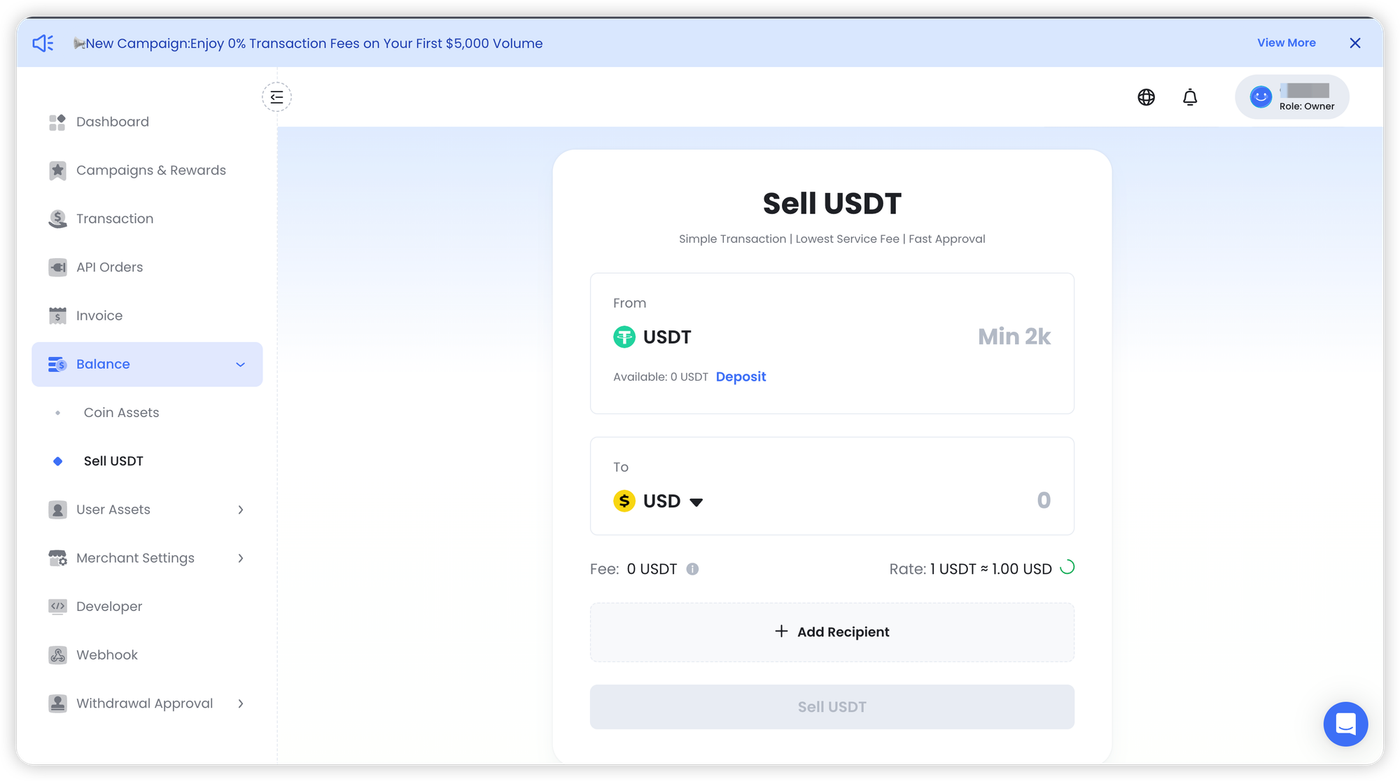
- Native USDT-to-USD Off-Ramp: Features a dedicated "Sell USDT" manual liquidation option within the dashboard, allowing merchants to convert stablecoin into USD bank deposits via manual exchange requests. This desk delivers swift settlement across highly flexible operational scales, processing single transaction volumes from 2,000 up to 1,000,000 USDT per request under a streamlined compliance framework.
Conclusion: Our Recommendation for 2026
When choosing a cryptocurrency payment gateway, you must align your provider with your operational scale and structural compliance limits.
If you are a Fortune 500 corporation managing audited cross-border legacy volumes, BitPay remains an established structural option. If your business is legally incorporated in the United States or Singapore and you require a fully custodial, compliance-first infrastructure that automatically yields on USDC, Coinbase Business serves as the direct institutional alternative. For decentralized, non-custodial community projects that require an expansive catalog of niche altcoins, NOWPayments provides practical utility.
However, for mid-market enterprises, scaling digital platforms, and global merchants looking to optimize high-frequency transactions, CCPayment provides the most efficient infrastructure on the market. By eliminating rigid single-use invoices, providing programmatic TRON energy cost reduction, and offering a direct 2,000 to 1,000,000 USDT-to-USD off-ramp desk, CCPayment operates as a comprehensive liquidation and settlement tool designed to protect your margins.
About CCPayment
The enterprise-grade crypto payment rail. Scale global commerce with an industry-low 0.2% fee, 900+ assets, and zero-code AI integrations.
🌐 Website: ccpayment.com → 📢 Official Channel: @CCPayment_Channel Join for weekly SaaS insights, Web3 trends, and API guides. 🤖 24/7 Support: @CCPaymentSupportBot
Crypto Adoption for Business 2026
Deep dives into Web3 payments, industry trends, and how to scale your global commerce with zero-code integrations.
FAQ
What is the best crypto payment gateway for SaaS and online stores in 2026?
There is no universal "best" platform. Large traditional enterprises with extensive legal teams heavily favor BitPay or Triple-A to match corporate balance-sheet auditing.However, for agile SaaS platforms, AI products, Telegram bots, and global SMEs looking to maximize checkouts while avoiding high fees, the optimal gateway must natively support the low-gas networks customers actually use. CCPayment provides the most pragmatic architecture for this segment, combining a 0.2% base processing fee with native TRON (TRC-20) and TON network integrations to eliminate checkout abandonment.
Which crypto payment processor offers the lowest total transaction costs?
When calculating infrastructure overhead, looking only at the advertised processing percentage is a major mistake. You must evaluate the total cost of ownership, which includes base transaction fees, hidden exchange rate spreads, and network gas pass-throughs. While legacy providers routinely charge 1.0% to 2.0% flat plus unlisted exchange markups, CCPayment maintains the lowest baseline fee tier in the internet payment space, charging a flat transaction rate starting down to 0.2% with zero hidden setup costs and transparent spreads, ensuring you retain the maximum percentage of your software margins.
What are the single-transaction limits for the CCPayment USD off-ramp?
The manual "Sell USDT" off-ramp desk inside the CCPayment dashboard processes flexible operational volumes ranging from a minimum of 2,000 USDT up to a maximum of 1,000,000 USDT per single transaction request. This compliance-aligned manual exchange pipeline converts stablecoin balances directly into USD bank deposits, completely bypassing third-party retail exchanges.
Can CCPayment be integrated into Telegram bots without complex coding?
Yes. CCPayment features Static Checkout Links that allow rapid, no-code deployment. Merchants can generate persistent standalone URLs straight from the dashboard and embed them directly into Telegram bots, Discord channels, or social media bio lines. The link automatically launches a unified, mobile-optimized Scan-and-Go checkout interface with auto-updating multi-chain QR codes, bypassing backend database integration.
How does the Sell USDT engine work, and what are the merchant KYC requirements?
CCPayment features a built-in Sell USDT to USD liquidation pipeline designed to turn digital revenue into predictable, real-world cash flow. Instead of forcing you to jump through hoops on external third-party consumer exchanges, you can convert your accumulated USDT straight into standard USD bank deposits inside your dashboard. To minimize onboarding drag for lean startups, this module operates under a highly streamlined, hassle-free identity verification process featuring exceptionally high approval rates. Merchants can automatically execute withdrawals and route USD cash back to their operational accounts as soon as their balance hits an accessible entry threshold of just $2,000.
Can a crypto payment gateway handle complex multi-tenant billing for SaaS models?
Yes, provided the gateway utilizes an account-centric ledger rather than a rigid, single-use invoice model. CCPayment is optimized specifically for advanced software subscription models, decoupling base chain verification from live account tracking to offer three flexible routing tiers:
- Permanent Deposit Address (EVM chains share the same string per user to eliminate transfer errors).
- Deposit Address for Order (for standard e-commerce carts).
- Wallet System Ledger Isolation (completely separating user deposits from core merchant assets to handle multi-tenant user balances or prediction markets seamlessly).
Featured on Medium