

CoinGate vs CCPayment: Fees, Supported Coins, and Payment Features Compared
Share
⏱️ TL;DR: CoinGate is a good fit for online stores that want automatic EUR conversion and SEPA withdrawals. CCPayment is a good fit for businesses that need to accept crypto across multiple blockchains, send batch payouts, or settle USDT in USD.
If you're switching to a new crypto payment gateway, start with the payments that give your team the most work. Maybe customers keep asking to pay on a network you haven't enabled, or finance has to convert balances before every payout run. Those are the details that determine whether switching saves time or money.
CoinGate and CCPayment differ in what customers can pay with, what merchants pay to process and move funds, and how finance teams can use the resulting balance. The comparison below covers each step from checkout to the final wallet or bank account.
CoinGate vs CCPayment: Company and Product Overview
What Is CoinGate?
CoinGate is a crypto payment gateway for businesses that provides checkout, invoicing, ecommerce plugins, and API integration. Its Standard plan charges 1% for payment processing. It also offers balance conversion and crypto payouts, giving merchants a reference point for comparing the cost of collecting, converting, and distributing funds.
What Is CCPayment?
CCPayment is a crypto payment gateway that lets businesses accept payments and manage funds in one merchant account. It supports 900+ cryptocurrencies across 100+ blockchains and offers hosted checkout, payment links, and API integration. Merchants can also convert crypto, send batch payouts, and request USD settlement from USDT.
CoinGate vs CCPayment: Feature Comparison
Feature | CoinGate | CCPayment |
|---|---|---|
Payment processing fee | 1% on Standard, with custom Enterprise rates | 0.2%–0.5%, based on monthly volume |
Crypto coverage | 10+ cryptocurrencies for merchant payments | 900+ cryptocurrencies across 100+ blockchains |
Payment integration | Hosted checkout, e-commerce plugins, and API | Hosted checkout, payment links, API, and reusable deposit addresses |
Crypto conversion | 1% on Standard | API Flash Swap at 0.1% for eligible $1–$1,000 orders, standard Dashboard Swap at 0.3% |
Conversion automation | Automatic checkout conversion and Convert API | Auto-Swap for eligible deposits and API Swap for existing balances |
Crypto payouts | Dashboard, CSV batches, and API | Batch Payout API, configurable withdrawal approvals, and Auto-Withdrawal |
Fiat settlement options | Includes EUR via SEPA and USD via SWIFT | On-demand USDT-to-USD settlement through supported banking routes |
A marketplace using CCPayment can assign reusable deposit addresses to returning users and use Auto-Swap to convert eligible deposits to USDT. It can then pay sellers in batches from that balance and settle a portion in USD.
Pricing and Transaction Fees: What Should Merchants Compare?
Compare fees using a typical month of payments. Include processing and any swaps, payouts, or bank transfers you expect to use.
Processing Fees
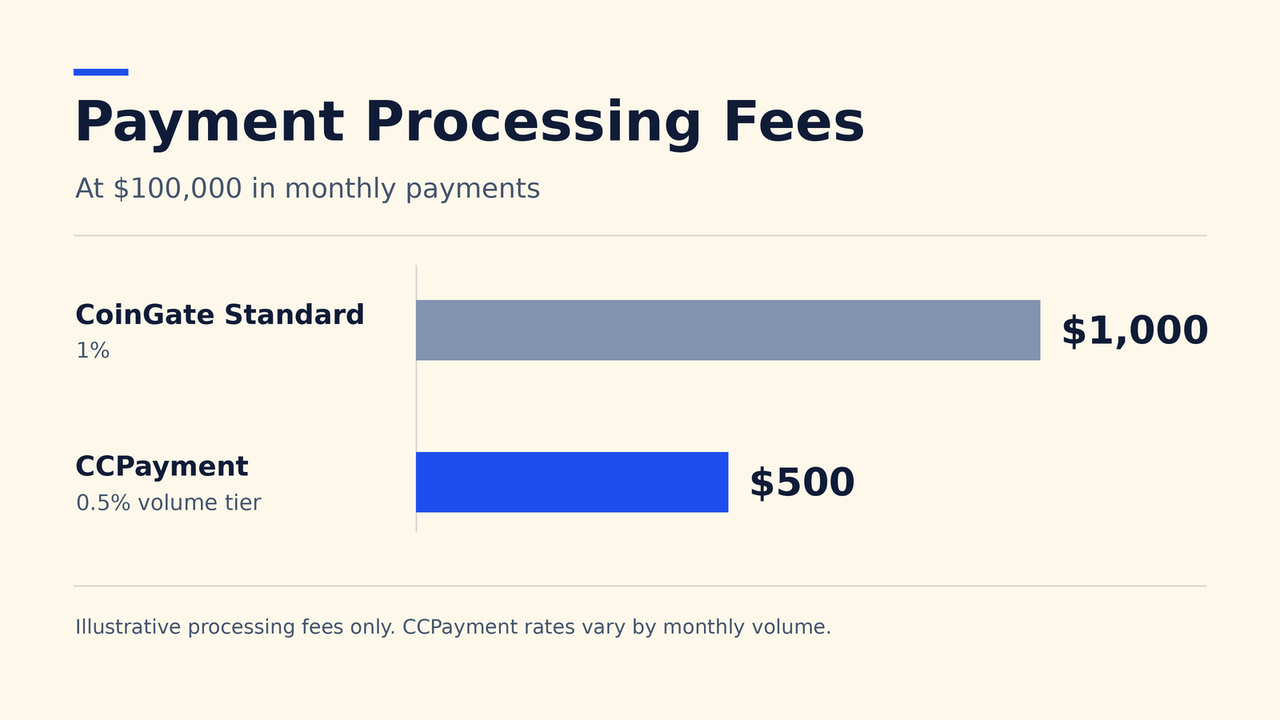
At $100,000 in monthly payments, CCPayment's 0.5% tier costs $500, compared with $1,000 at CoinGate's 1% Standard rate. That's $500 less in processing fees for the same volume. CCPayment's rates range from 0.2% to 0.5% based on monthly volume, with the 0.2% tier starting at $10 million. CoinGate also offers custom Enterprise rates. See CoinGate's official pricing.
Conversion and Swap Fees
For an eligible $10,000 manual balance swap, CCPayment's 0.3% standard Dashboard Swap fee comes to $30, compared with $100 at CoinGate's 1% Standard rate. That's $70 less in swap fees. Compare the net amount in each quote to account for exchange rates.CCPayment also charges 0.1% for eligible API Flash Swap orders worth $1–$1,000. See CCPayment's Swap 2.0 guide.
Withdrawal and Payout Fees
CCPayment charges no platform fee for standard Dashboard and API crypto withdrawals. Blockchain network fees still apply. For automated or batch payouts, check the total cost per recipient, including any conversion.
Fiat Settlement Costs
CoinGate supports SWIFT withdrawals from an existing fiat balance. CCPayment lets merchants convert USDT to USD and settle to a bank account, with a 2,000 USDT minimum. Eligible merchants can get the percentage-based fee waived on up to 2,000 USDT of their first USD settlement. Ask the CCPayment team if you qualify and review the fees and estimated USD payout before confirming. See CCPayment's Fiat Off-Ramp.
Payment Integration and Merchant Operations
CCPayment's hosted checkout serves businesses that need a payment page for each order. Reusable deposit addresses serve platforms that need to credit returning users who top up repeatedly. Both workflows can use the CCPayment Payment API.
For recurring disbursements, the Batch Payout API lets operations teams submit transfers to multiple wallet addresses in one request. Engineering teams can match payout records to their own recipient or order IDs, while finance teams can configure withdrawal approval rules for transfers that require review. During testing, follow a payment from its original order through webhook notification, balance credit, and payout reconciliation.
Settlement and Treasury Management
Say your marketplace has 30,000 USDT in its CCPayment balance. You owe sellers 18,000 USDT on Friday and need $8,000 in the bank the following week. Set aside the seller payments and their estimated network fees first. Then use the USD settlement quote to see whether the remaining USDT can cover the $8,000 after fees. If you're short, you can get a Swap 2.0 quote to convert another supported asset into USDT.
CoinGate or CCPayment: Which Is Better for Your Business?
- Ecommerce with EUR settlement. CoinGate is a good fit if your store uses a supported ecommerce plugin and your finance team wants crypto sales converted to EUR at checkout, with withdrawals via SEPA.
- Ecommerce and digital services. Consider CCPayment if customers regularly request more payment assets or networks and you want to keep your existing storefront while adding hosted crypto checkout.
- SaaS and platforms with repeat deposits. Evaluate CCPayment as a CoinGate alternative if you need to link top-ups to specific users and convert part of your revenue into a preferred treasury asset.
- Marketplaces, affiliates, and iGaming. Both gateways support API payouts. Shortlist CCPayment if you want recurring payouts to draw on a stablecoin balance that also funds separate USD settlements. Check approval workflows and confirm account and jurisdiction eligibility before a rollout.
For a broader crypto payment gateway comparison, see CryptoTotem's guide to crypto payment gateways for businesses.
Conclusion: Choose the Gateway That Fits Your Payment Workflow
Talk to the CCPayment team on Telegram. Share your most-used token and network combinations, monthly payment volume, and typical payout sizes to get a cost estimate and test one complete workflow before switching.
Crypto Adoption for Business 2026
Deep dives into Web3 payments, industry trends, and how to scale your global commerce with zero-code integrations.
FAQ
Q1: Can I switch from CoinGate to CCPayment one payment flow at a t
A: Yes. A business can begin with one payment flow, store, customer segment, or payout run while keeping existing CoinGate orders active. Before expanding, test payment creation, webhook verification, reconciliation, refunds, withdrawals, and settlement under production-like conditions.
Q2: Can I settle in USD if my customers pay in BTC or USDC?
A: If the required trading pair is supported, eligible CCPayment merchants can convert the received asset into USDT through a separate Swap order and then submit a USDT-to-USD settlement request. Swap availability, fees, settlement eligibility, compliance review, and banking routes should be checked separate
Q3: Why does network coverage matter when comparing crypto payment gateways?
A: Supporting USDT is not enough if the gateway does not support the network customers and payout recipients actually use. Businesses should compare deposit and withdrawal availability, minimum amounts, confirmation requirements, and network fees for each required token-network combination before migrating.
Q4: Which provider is more suitable for businesses paying affiliates or marketplace sellers?
A: Both providers offer crypto payout capabilities. The better fit depends on batch limits, payout fees, approval controls, recipient-data requirements, supported networks, and reconciliation records. Businesses should model one representative payout run rather than comparing payment-