Beyond Speculation: Why Gemini’s $100M Bet Proves Stablecoins Are the New Market Infrastructure
⏱️ TL;DR: Stablecoins are now core market infrastructure. This paper explores the tech behind the latest $100M institutional shift, analyzing why legacy omnibus architectures fail and how parallel sub-wallets solve 2026 compliance hurdles.

The Capital Drag: Friction of Traditional Banking Rails
When high-volume alternative asset platforms rely on legacy correspondent bank wires or traditional clearing networks to move fiat, they face deep capital drag that directly destroys platform scalability:
- Manual Operational Overhead: Managing separate banking entities across multiple jurisdictions requires intensive manual reconciliation cycles for internal finance teams.
- Settlement Latency: Waiting for regional clearing windows to open or chasing wire confirmations kills transaction momentum for real-time digital markets.
- Disrupted User Experience: Multi-hour funding delays alienate high-net-worth (HNW) whales who demand instant deployment of capital.
This is why top-tier platforms are ditching bank loops altogether. By treating stablecoins as programmable database infrastructure, trading desks can move balances globally 24/7. But to actually handle this programmable liquidity, your backend wallet mode has to be built for extreme velocity.
The Surge of Tokenized Private Equity & Prediction Markets
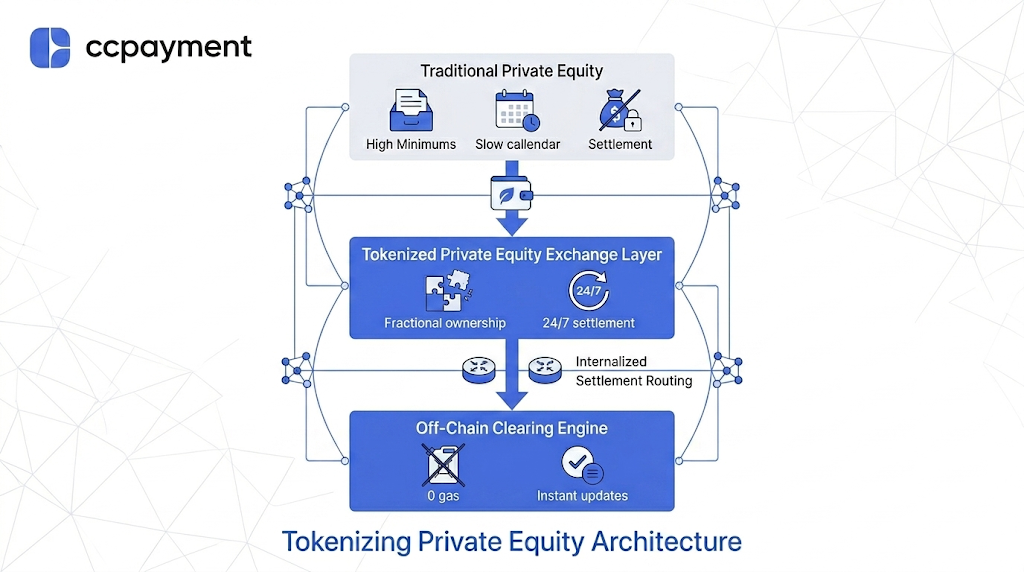
Key InsightLarge pre-IPO liquidity pools and global forecasting platforms introduce transaction densities that easily break static legacy databases and early Web3 configurations.
The growth of tokenized private markets and large-scale prediction platforms introduces operational workloads. Today’s digital asset environments handle rapid, continuous shifts in fractionalized asset distribution.
This includes tracking secondary market exposure for pre-IPO tech giants—exemplified by recent industry milestones showing SpaceX equity trading actively on-chain—breaking down venture capital allocations into fractional shares, and running forecasting networks that manage millions of live positions concurrently.
🛑 The Execution WallHigh-frequency forecasting networks and fractionalized equity venues cannot scale economically when broadcasting every single micro-transaction directly to a public mainnet main layer.
Traditional cap table software or simple SQL instances were never engineered to absorb this type of volume. A single high-profile market resolution or a rapid private share reallocation can trigger millions of internal balance recalculations across a platform within a tight window.
When a platform attempts to clear fractionalized assets at scale, legacy setups experience severe data fragmentation: the core matching engine updates trading positions within milliseconds, leaving the asset custody layer struggling to keep pace.
Private market liquidity is moving on-chain because investors and early employees increasingly seek secondary market options long before a company reaches a formal IPO. Modern tokenized exchanges require a clear structural split to sustain volume: securities regulators are modernizing legal frameworks to manage this digital clearing trend, meaning operators can no longer rely on rigid, siloed databases.
Why Public Chains Break During High-Concurrency Events
Public blockchains function efficiently as permanent global settlement validation layers, but they fail economically as real-time, high-frequency execution environments.
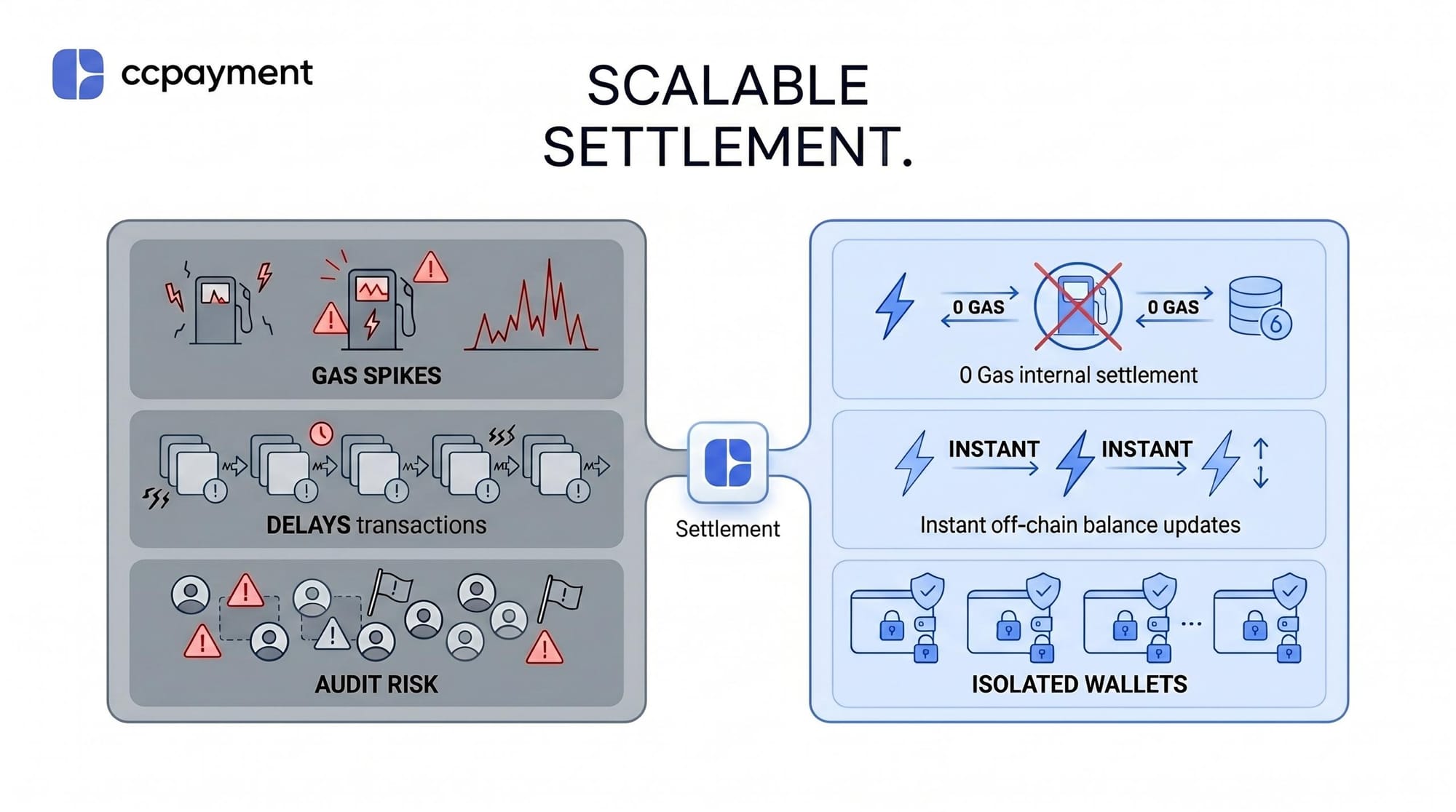
A high-volume prediction market generates massive transaction bursts during event resolution windows. These intense spikes typically manifest during geopolitical elections, sports tournaments (such as the upcoming 2026 World Cup), and macroeconomic contract closures. When a major market resolves, platforms must process tens of thousands of position payouts within minutes. If every internal balance update requires a direct broadcast to a public mainnet, the architecture encounters the Nonce Serialization Bottleneck.
The Anatomy of Public Network Bottlenecks
- Gas Spikes and Spread Compression:
During major event resolution windows, thousands of winning and losing positions must be updated simultaneously. On public chains, every state update competes for limited block space. As transaction demand rises, gas fees surge rapidly. If you operate on thin spreads, network gas spikes will literally eat your revenue, turning peak engagement into net losses. - Mempool Congestion and UI Latency:
Congested mempools stall transaction execution, freezing user balances during peak volume windows. When transactions hang in the queue, the frontend user interface falls out of sync with the actual chain state. This latency triggers user complaints, erodes trust, and ultimately drives platform churn. - Micro-Settlement Friction: Public networks cannot economically clear millions of low-value, high-frequency internal transactions when each broadcast requires gas, leaving platform balance sheets exposed to unpredictable, volatile public transaction fee markets.
To survive high transaction loads, operators must move away from architectures exposed to direct mainnet friction and manual cross-chain inventory dependencies.
Why Omnibus Wallet Models Have Become a Compliance Liability
Pooling customer deposits into shared omnibus accounts creates single points of failure and operational ledger drift.
To bypass mainnet fee congestion, many legacy exchanges pool all customer assets into a single omnibus wallet address. They track individual balances entirely inside an internal SQL database. While simple on day one, this setup introduces severe regulatory and operational vulnerabilities.
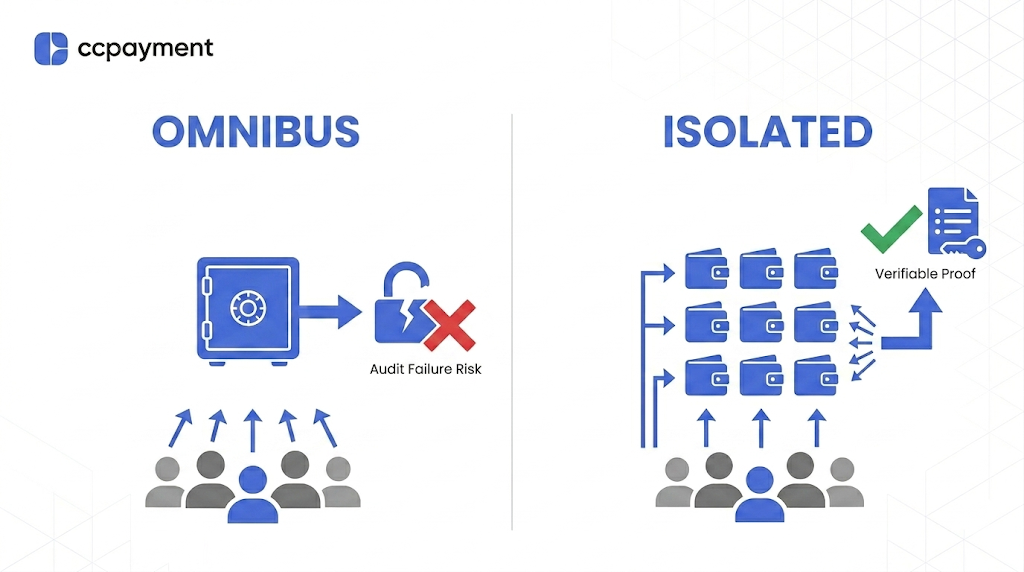
[Legacy Omnibus Pool]
Client Funds ──► Single Pooled Corporate Wallet ──► Ledger Drift & Co-mingling Risk (Non-Compliant)[CCPayment Decoupled Infrastructure]
User 001 ──► Isolated Sub-Wallet A ──┐
User 002 ──► Isolated Sub-Wallet B ──┼──► Hybrid Clearing Engine (0 Gas Internal Settlement)
User 003 ──► Isolated Sub-Wallet C ──┘
Under intense, high-concurrency market resolutions, internal SQL databases frequently drift from pending on-chain realities. This internal ledger drift creates structural accounting discrepancies and blind spots during independent third-party audits. Furthermore, mixing client trading balances, operational gas funds, and corporate capital within a single unsegregated pool violates core anti-co-mingling statutes.
Regulators like HKMA and MAS now strictly mandate physical asset segregation. Alongside strict SBC Compliance Requirements for Prediction Market Fund Segregation, regulators like the Hong Kong Monetary Authority (HKMA) stablecoin sandbox framework and the Monetary Authority of Singapore (MAS) custodial guidelines strictly mandate:
- Physical asset segregation at the individual user level.
- Real-time, transparent per-user custody attribution.
- Total prevention of co-mingling client capital with corporate operational assets.
Omnibus configurations cannot generate clean, user-level reserve proofs. This makes them fundamentally incompatible with modern licensing requirements.
The Solution: CCPayment User Wallet System
The CCPayment User Wallet System functions as a hybrid settlement infrastructure, transforming public blockchains into verification layers while offloading real-time execution.
Unlike standard crypto payment gateways that rely on pooled deposit routing, the CCPayment framework delivers reliable reserve attribution and internal balance clearing at scale without exposing the platform to mainnet fee volatility. The system automatically provisions permanent, isolated deposit addresses (sub-wallets) mapped uniquely to individual user IDs through the custodial wallet API layer.
Architecture Performance Comparison
| Performance / Ledger Attribute | Standard Gas-Sweep Models | CCPayment Hybrid Sub-Wallet Architecture |
|---|---|---|
| High-Concurrency Event Payouts | Mainnet queue congestion; transaction costs can exceed matching revenue streams. | Instant internal batch clearing; 0 Gas internal settlement for intra-platform state updates. |
| Fractional Private Share Allocation | Frequent small-increment updates trigger constant, margin-draining on-chain routing costs. | Balances modify instantly via an off-chain ledger for prediction markets; mainnet hits occur only at withdrawal layers. |
| Sovereign Audit Compliance | Manual snapshot accounting across pooled addresses; high risk of internal ledger drift. | Clear, 1:1 cryptographic sync loop between the off-chain database and isolated sub-wallets. |
Core Infrastructure Capabilities
- Dedicated Wallet Separation
The system auto-provisions distinct blockchain addresses for individual clients. This guarantees absolute asset segregation right out of the box. It satisfies strict HKMA and MAS compliance standards without requiring complex multi-chain development overhead from your internal engineering team.
- 0 Gas Internal Clearing
While base custody remains anchored to individual blockchain addresses, all active trading, matching, and payouts execute through a secondary clearing ledger layer. When users trade tokenized shares or place bets, the off-chain system updates balances internally and instantaneously. The public blockchain queue is bypassed entirely during active trading, unlocking 0 Gas internal clearing and shielding operations from gas hikes.
- Proof of Reserves (PoR)-Ready Design
Platforms require segregated account structures to pass modern third-party audits. Because each user balances on the internal ledger maps directly to an isolated on-chain address, the platform can generate real-time cryptographic proofs automatically.
Conclusion: Optimizing Architecture for the Next Era of Digital Markets
Sustaining a modern tokenized marketplace requires three core elements: continuous system availability, clear audit verification, and stable transaction execution. The industry is converging toward a unified hybrid framework where different systems handle segregated ledger roles:
- Stablecoins function as the base programmable settlement rail.
- Public Blockchains serve as the verification layer for state validation.
- Internalized Ledgers operate as the high-throughput transaction execution engine.
- Isolated Sub-Wallets act as the regulatory-compliant client custody framework.
The shift toward tokenized private equity and high-frequency prediction markets is accelerating. Gemini’s landmark $100M strategic deployment into compliant prediction market infrastructure following its CFTC DCO license proves that institutional dollars require institutional architecture. Do not let gas spikes or omnibus wallet risks disrupt user settlements during peak trading activity.
👉 [Apply for the CCPayment Wallet System API Here] Deploy isolated user sub-wallets, enable 0 Gas internal clearing, and build a Proof of Reserves (PoR)-ready system with enterprise fees starting as low as 0.2%.
FAQ
Q1: How does your wallet infrastructure prevent asset co-mingling and audit risks?
A: Old crypto gateways pool all client funds into a single "omnibus" wallet, which makes auditing a nightmare and causes compliance issues. CCPayment replaces this with automated user account isolation. Through our API, every user gets their own dedicated blockchain address (sub-wallet). Your corporate funds and client assets stay completely segregated, making it easy to pass routine audits and satisfy strict HKMA and MAS regulatory standards.
Q2: Since trades happen off-chain, how can the platform maintain a reliable Proof of Reserves (PoR)?
A: Easily. Even though high-frequency matching and contract payouts happen instantly on our internal ledger to save costs, the balances are directly tied to each user's isolated on-chain sub-wallet. The system maintains a constant 1:1 cryptographic sync between your internal database and the actual blockchain state. You can generate a clean Proof of Reserves (PoR) at any time to prove to regulators and users that their funds are 100% backed.
Q3: How does your stablecoin infrastructure eliminate network gas fees during major traffic spikes?
A: We use a hybrid approach that separates asset custody from live transaction execution. Mainnet blockchain transactions are used only when users make a deposit or a withdrawal. When users place bets or trade inside your app, everything clears instantly through our secondary internal ledger layer. This completely bypasses public mempool congestion and wipes out gas fee overhead during high-concurrency windows, keeping your profit margins safe even during peak events like the 2026 World Cup.
Q4: Why are tokenized private equity exchanges shifting to this custodial wallet API?
A: Trading fractionalized real-world assets (like on-chain SpaceX equity) creates thousands of micro-transactions every second. Standard databases easily fall out of sync, and public chains are too expensive for small-scale balance adjustments. Our custodial wallet API automates wallet generation for millions of users instantly, allowing you to run smooth, 24/7 fractional share settlements while keeping a crystal-clear, independent audit trail for every single account.
Q5: Can this single custody layer handle both mainstream stablecoins and custom RWA tokens?
A: Yes. CCPayment natively supports over 900 digital assets across all major blockchains (compared to the legacy industry standard of around 350 tokens). This means you can settle popular stablecoins (USDT, USDC, $XAUt) alongside unique real-world asset (RWA) tokens under one unified interface. It keeps your engineering setup simple and predictable, with an industry-low processing fee starting at just 0.2%.
Crypto Adoption for Business 2026
Deep dives into Web3 payments, industry trends, and how to scale your global commerce with zero-code integrations.