

What Crypto Gateways Won't Tell You: 5 Red Flags for Merchants in 2026
Share
By 2026, with recent PayPal research revealing that 84% of merchants expect crypto payments to become standard, accepting digital assets is no longer a "nice-to-have" feature; it’s a baseline requirement.
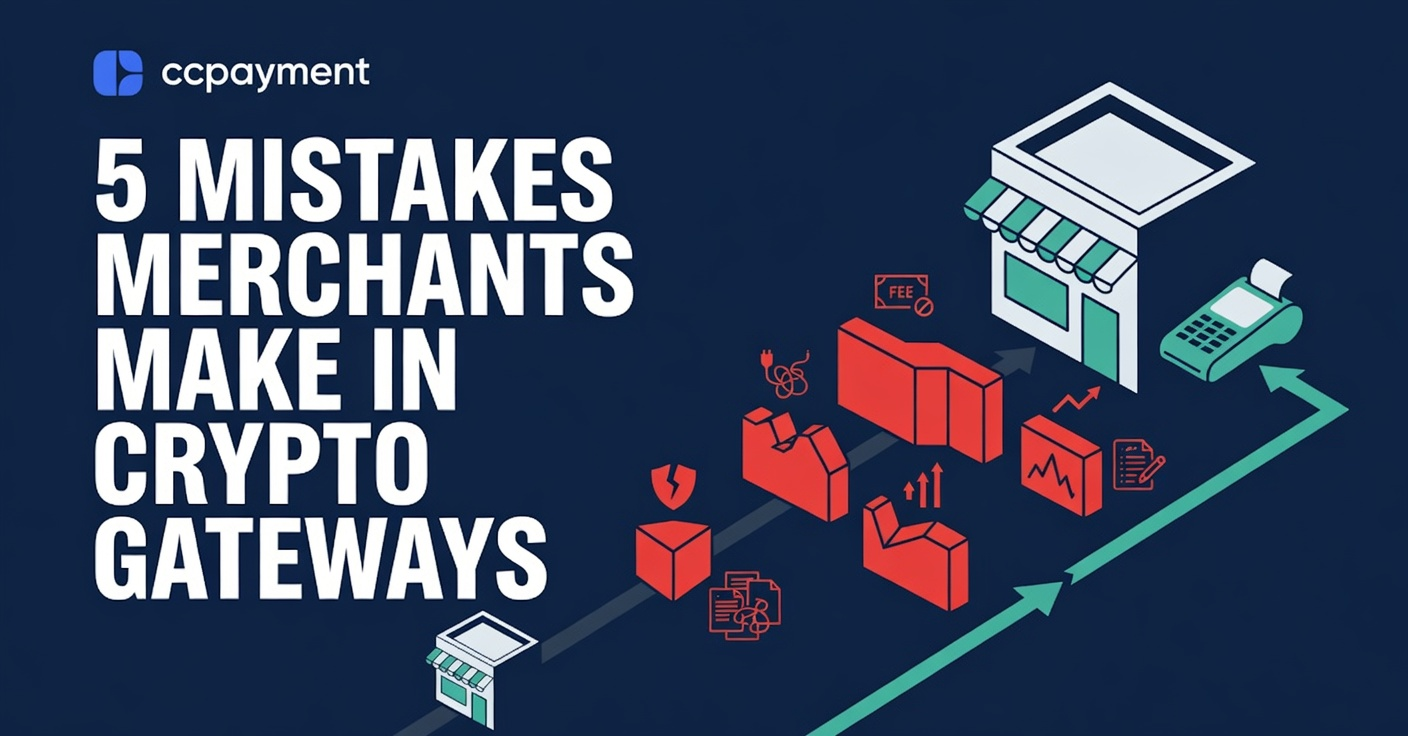
By 2026, with recent PayPal research revealing that 84% of merchants expect crypto payments to become standard, accepting digital assets is no longer a "nice-to-have" feature; it’s a baseline requirement.
However, the journey into integrating a reliable crypto payment gateway is often a minefield. Choosing the wrong infrastructure doesn't just inflate your hidden crypto payment integration cost—it can lead to frozen bank accounts, weeks of wasted engineering time, and massive cart abandonment during the Web3 checkout process.
To help you secure the best crypto gateway 2026 for your business, we have analyzed the 5 most critical (and expensive) mistakes merchants make when entering the space.
🚩 Red Flag 1: Confusing User Privacy with Financial Risk (Neglecting KYT)
The core ethos of the Web3 movement is self-custody and financial privacy. Many shoppers specifically prefer to transact without uploading their passports or revealing physical identities.
This introduces a massive compliance dilemma: to avoid losing privacy-conscious customers, some merchants choose underground, "no-KYC" gateways, risking interaction with money laundering rings or internationally sanctioned entities.
This is a fatal error. Following the mandates established in the FATF June 2025 Targeted Update, global regulators have moved from warnings to enforcement. The watchdog explicitly warns that businesses failing to implement real-time preventative measures now risk being labeled as a 'high-risk entity,' leading to the immediate denial of access to traditional banking infrastructure. In the past, the only fix was forcing rigorous KYC (Know Your Customer) identity checks before checkout, causing up to 70% cart abandonment.
But as we detailed in our recent product update on Real-Time KYT security, Privacy does not have to equal Risk.
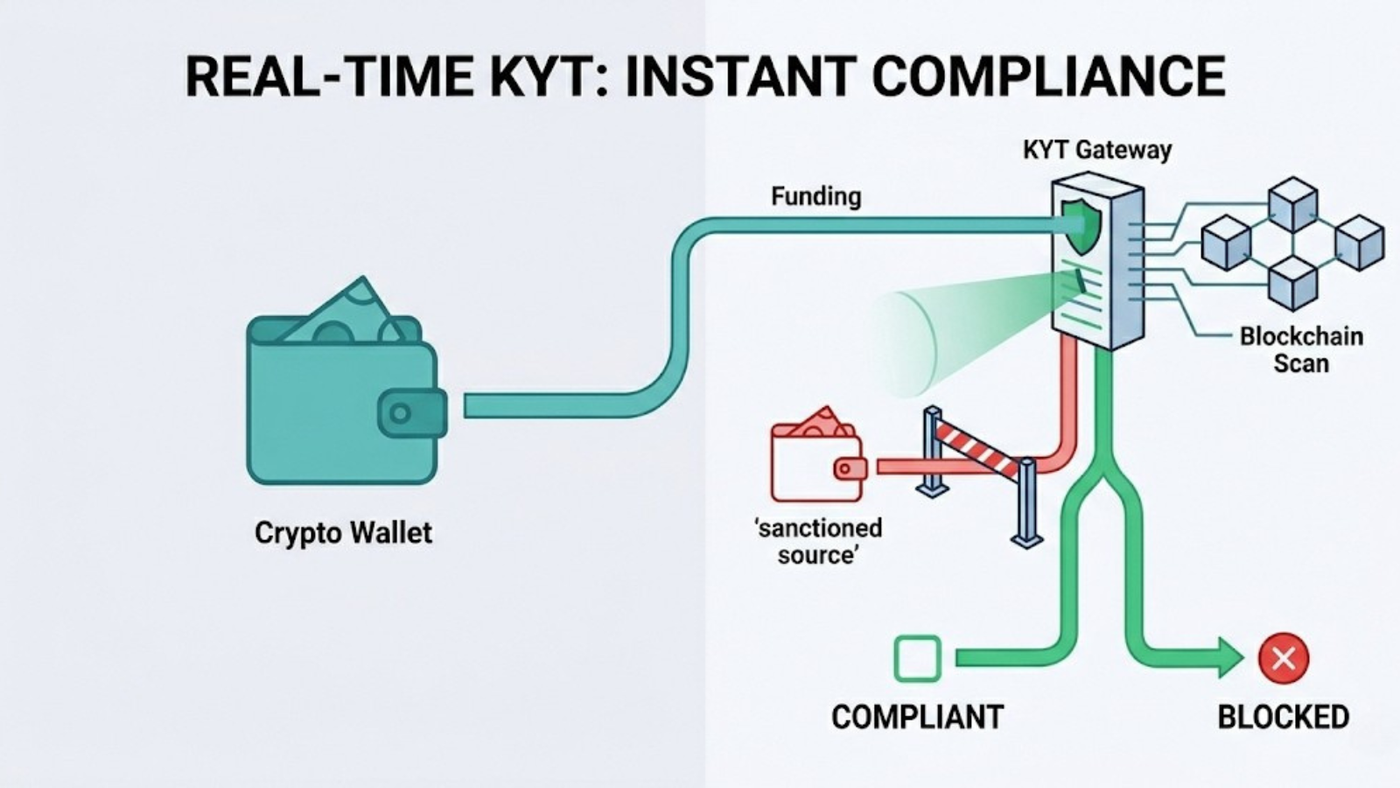
The modern solution is Real-Time KYT (Know Your Transaction). Instead of verifying who the customer is, an enterprise-grade gateway verifies what the funds are.
The moment a wallet connects, the engine scans the blockchain history. If funds originate from a sanctioned source, they are instantly blocked.
You achieve 100% regulatory compliance and keep your corporate treasury completely unpolluted for fiat off-ramping—all without breaking the frictionless, pseudonymous experience crypto-natives demand.
🚩 Red Flag 2: Underestimating the "Crypto Payment Integration Cost"
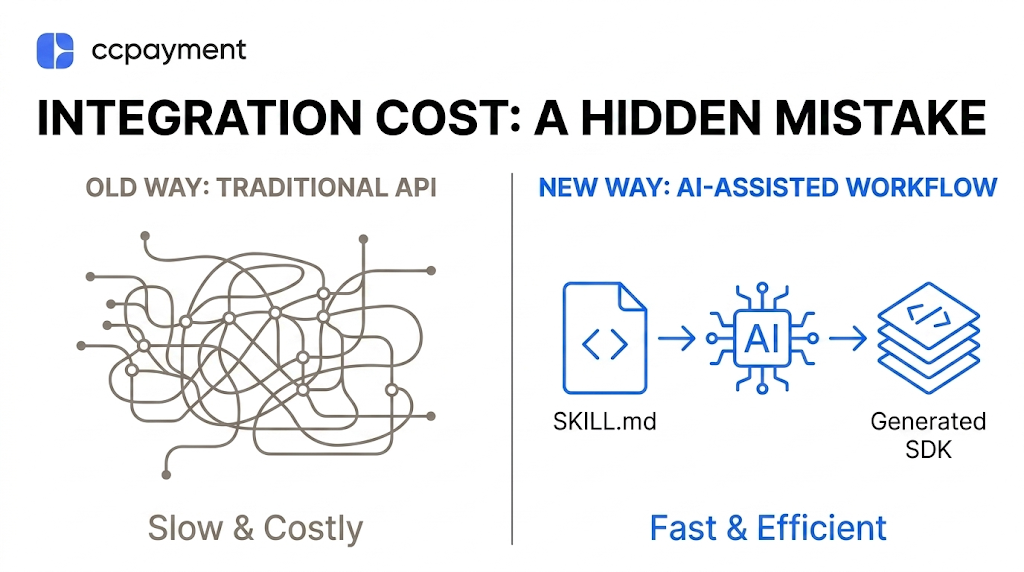
When evaluating new gateways, merchants usually focus on transaction fees, but it's easy to overlook the hidden crypto payment integration cost.
Traditional API integration can be highly time-consuming. If your development team needs to spend days or even weeks reading extensive documentation, manually constructing custom signature logic (like HMAC-SHA256), and testing Webhooks, those hours quickly add up to a significant hidden operational cost.
Today, the industry is shifting toward more efficient, AI-assisted workflows to reduce this overhead. For instance, as shown in our official API documentation, CCPayment offers an AI-optimized SKILL.md framework.
Developers can leverage AI tools (like Cursor or Claude) to read this file and assist in generating strongly-typed SDKs, significantly shortening the integration cycle.
Choosing a developer-friendly infrastructure helps your team save valuable sprint time and keeps your project on budget.
🚩 Red Flag 3: The "Zero Fee" Marketing Trap
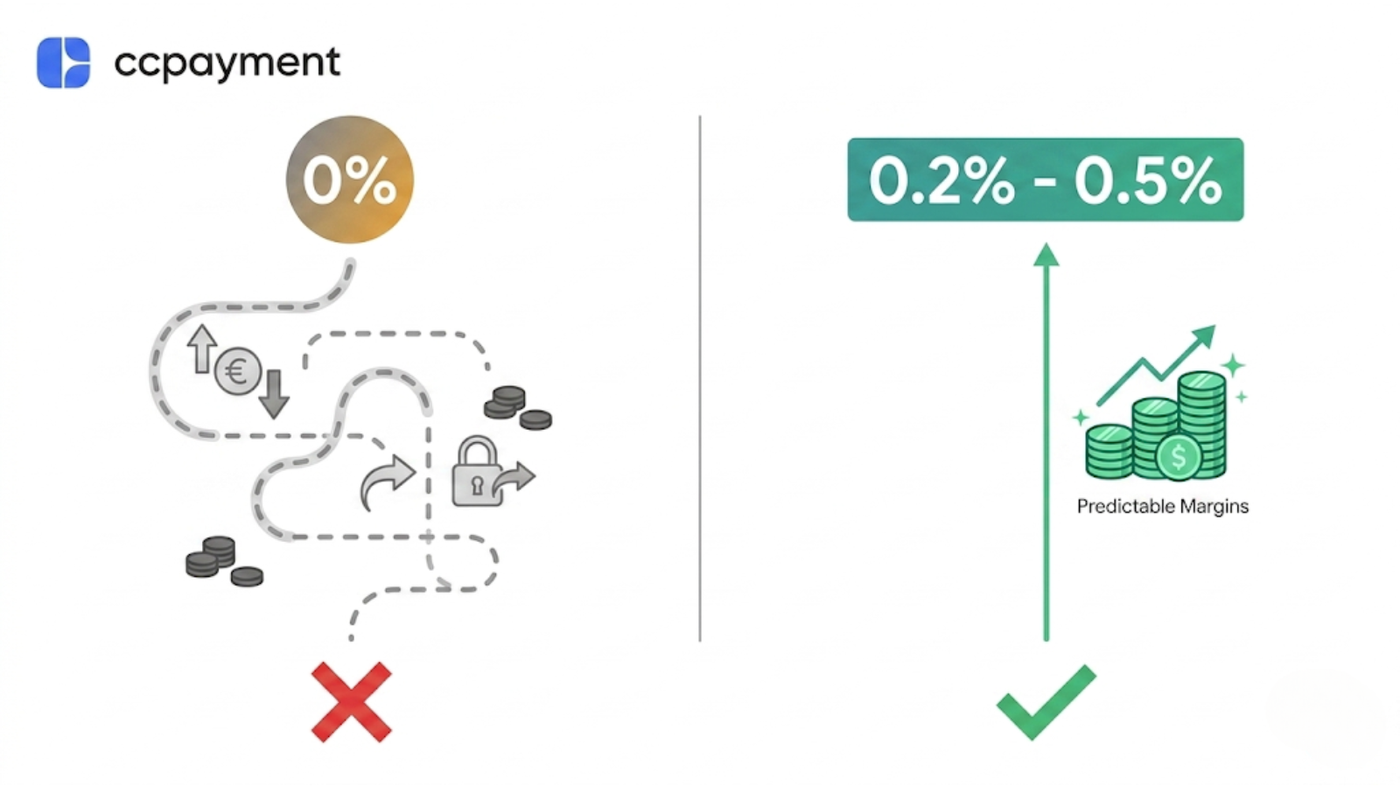
Some gateways advertise "0% Transaction Fees" to attract unsuspecting merchants. However, in the payment industry, there is no such thing as a free lunch. If a platform isn't charging a transparent processing fee, they are monetizing your business through hidden backdoors:
- Exchange Rate Markups (The Spread): They give you a significantly worse conversion rate than the real-time market, silently hiding their profit within the spread. You might think you are paying 0%, but you are actually losing 2-3% on every transaction.
- Exorbitant Withdrawal Fees: They lure you in with free deposits, but when you attempt to move your funds to a cold wallet or a centralized exchange to cash out, you are hit with massive, unexplainable "network handling fees."
When evaluating a gateway, prioritize radical transparency over marketing gimmicks. A reliable provider will publish its exact rates upfront.
For instance, rather than hiding costs in exchange spreads, CCPayment utilizes a transparent 0.2% to 0.5% tiered deposit fee based on your transaction volume.
What you see on the pricing page is exactly what you pay, ensuring your business's profit margins remain predictable and protected.
🚩 Red Flag 4: High Gas Fees and Rigid Chain Support
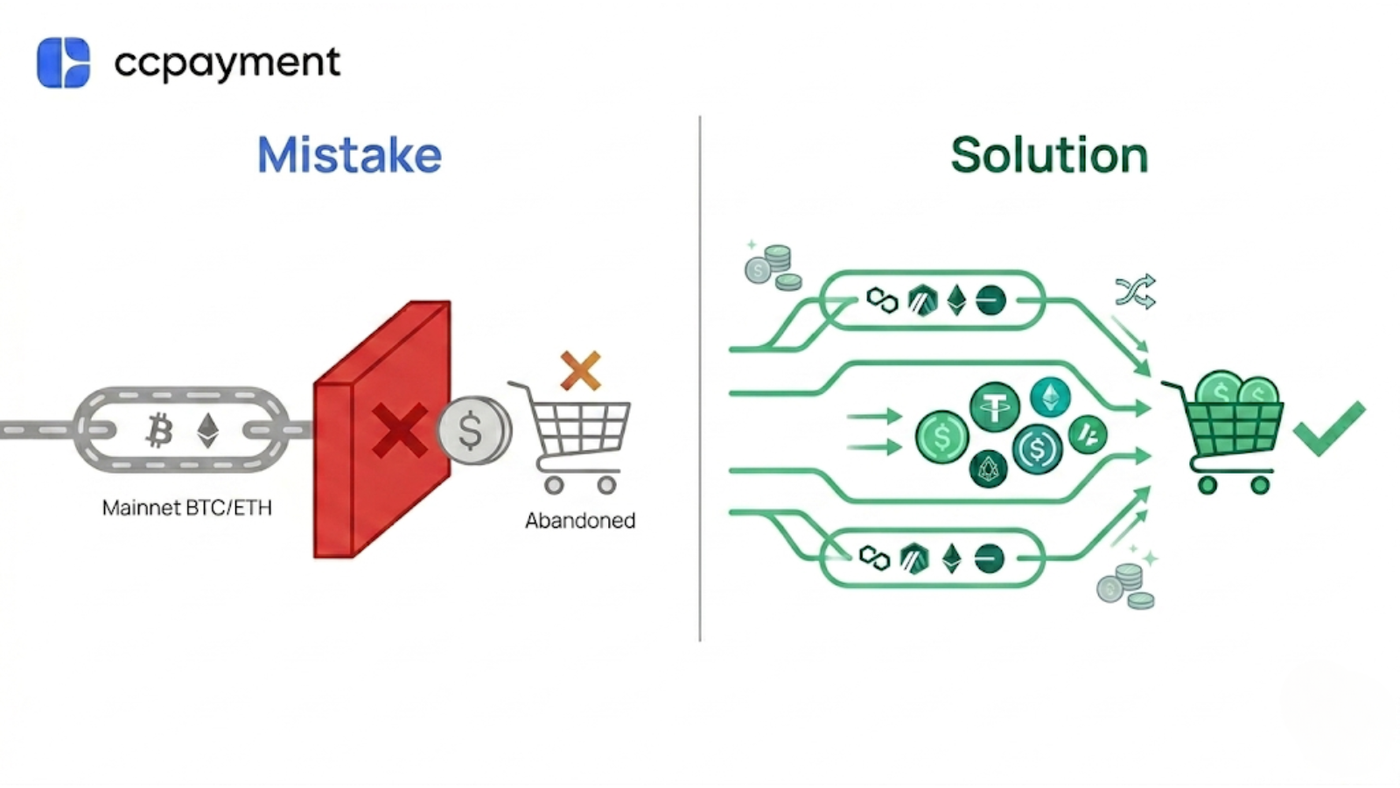
A common pitfall is selecting a gateway that only supports a handful of foundational coins like Bitcoin or Ethereum on their mainnets.
While these assets are essential, restricting payment options to them is a direct catalyst for cart abandonment. If a customer buying a $50 item is forced to pay a $20 Ethereum gas fee, they will simply close the tab.
The cost of a rigid payment stack is staggering. As highlighted in a recent PYMNTS intelligence report on the "Checkout Walkout", merchants consistently underestimate how payment friction destroys conversion. Consumers now demand "speed and multiple formats," and if your checkout lacks the flexible networks they prefer, your revenue will evaporate.
In 2026, the Web3 economy is driven by low-cost Layer 2 networks (such as Polygon, Arbitrum, or Base) and rapid liquidity shifts.
Modern shoppers want to pay with stablecoins (like the newly migrated USDS) on fast, cheap chains.
To capture maximum revenue and stop checkout walkouts, merchants must deploy an agile infrastructure that inherently supports hundreds of tokens across various low-fee networks.
🚩 Red Flag 5: Overlooking Post-Payment Volatility and Reconciliation
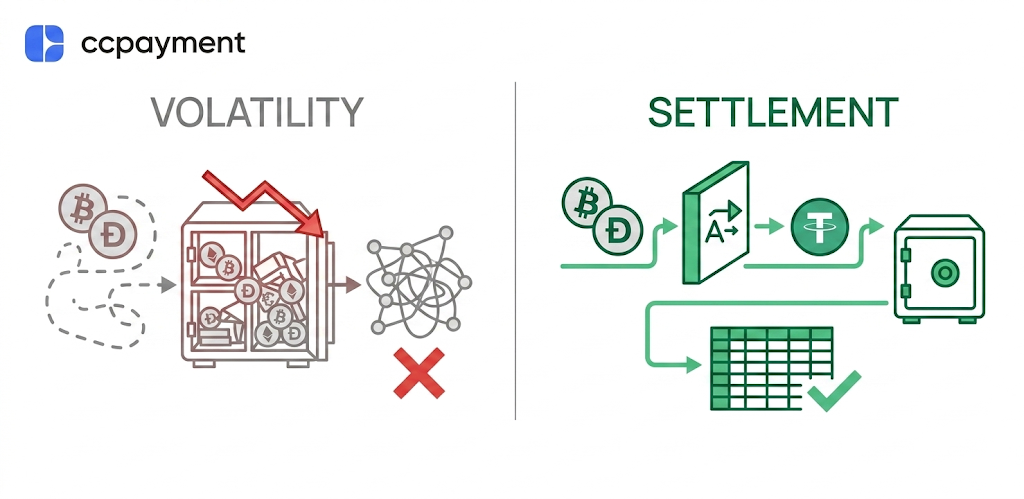
Many merchants believe the transaction is complete the moment a customer sends the crypto. This is a costly misconception.
If your gateway simply dumps 15 different volatile tokens (like DOGE, BTC, or SOL) into your merchant wallet, you are inheriting an operational nightmare.
First, your profit margins are instantly exposed to market volatility. A $100 payment could drop to $85 before you even have the chance to move it to an exchange.
Second, your accounting team is left with the agonizing task of reconciling hundreds of micro-transactions across different blockchains and fluctuating price points at the end of the month.
In 2026, enterprise checkout is about protecting the treasury. A modern crypto gateway must feature Instant Stablecoin Auto-Settlement.
When a customer pays in any volatile token, the system should automatically and instantly convert it into a baseline stablecoin (such as USDT or the new USDS) upon receipt.
This completely eliminates price slippage, protects your profit margins, and ensures your financial reporting is as clean and predictable as traditional fiat processing.
The 2026 Standard: Legacy Gateways vs. AI-First Infrastructure
Choosing the best crypto gateway 2026 comes down to avoiding these five fatal flaws. Here is how traditional setups compare to a modern, AI-ready infrastructure like CCPayment:
Feature / Metric | Legacy Crypto Gateways | CCPayment Enterprise Gateway |
|---|---|---|
Integration Cost | Weeks of manual coding & debugging | < 10 Mins via AI Agent (SKILL.md) |
Compliance Risk | "No-KYC" blind spots (High risk) | Real-Time KYT Security (No frozen accounts) |
Pricing Model | 0% Fee traps with hidden exchange spreads | 0.2% - 0.5% Tiered Fee (Radical transparency) |
Checkout Abandonment | High (High gas fees on mainnets only) | Low (L2 networks & agile USDS support) |
Treasury Protection | Manual handling of volatile tokens | Instant Auto-Settlement to Stablecoins |
Stop Building, Start Scaling.
Don't let engineering bottlenecks or compliance risks hold your business back. By avoiding these common mistakes, you position your brand at the forefront of the Web3 economy.
Why spend weeks forcing your developers to read API manuals?
Explore our AI-Ready API Documentation today. Just feed our SKILL.md to your AI Agent, and watch it generate a production-ready, strongly-typed SDK client in under 10 minutes. Grab a coffee, and launch your checkout today!
About CCPayment
CCPayment offers an industry-low 0.2% service fee alongside 900+ cryptocurrency support, protecting your global business 24/7.
🔗 Explore the future of payments: ccpayment.com
🤖 Contact us: @CCPaymentSupportBot
FAQ
How can I effectively reduce the "crypto payment integration cost"?
Traditional integration often requires significant engineering hours to handle custom signature logic and Webhooks. By utilizing modern, developer-friendly platforms that offer AI-optimized documentation (like CCPayment's SKILL.md), you can substantially lower this cost. While developers still need to review the generated code to ensure it fits specific business logic (as AI can occasionally hallucinate), leveraging an AI Agent can help generate the foundational SDK client in minutes, saving valuable sprint time.
What is Real-Time KYT, and why is it important for compliance?
Real-Time KYT (Know Your Transaction) is a preventative measure that analyzes the blockchain history of funds. If your gateway lacks proper AML mechanisms, you risk interacting with sanctioned entities, which can lead to your business being labeled a "risky business." KYT is designed to intercept high-risk funds before they settle, helping merchants maintain a compliant treasury without forcing normal users through excessive identity checks.
How does Instant Auto-Settlement protect my profit margins?
We believe accepting crypto shouldn't require you to become a market trader. Instant Auto-Settlement acts as an invisible price lock. The exact second a customer completes a purchase, our system automatically converts their payment into stablecoins (like USDT or USDS). This means if you price an item at $100, you secure exactly $100 in value. You can offer flexible global payment options to your customers while your accounting remains as straightforward and predictable as traditional fiat.
How do we prevent users from abandoning their carts during crypto checkout?
Legacy checkouts force users into manual labor—copying long wallet addresses and calculating network gas fees—which leads to underpayments and frustration. CCPayment’s Hosted Checkout delivers a seamless, Web2-style experience in a Web3 world. We generate dynamic QR codes and freeze the exchange rate with a countdown timer. The user simply scans and pays. Zero math, zero friction, higher conversion rates.
What key features should I look for when evaluating the best crypto gateway in 2026?
In 2026, you shouldn't settle for basic plumbing. A modern gateway must deliver three non-negotiables:
1) AI-Native DX: Machine-readable APIs that integrate in minutes, not days.
2) Institutional Compliance: Built-in Real-Time KYT and support for regulated stablecoins (like USDS).
3) Absolute Profit Protection: Instant auto-settlement with transparent, tier-based pricing and zero hidden markups. If your current gateway lacks these, you are paying for legacy infrastructure.