Product Update: Frictionless USDS Checkouts, Auto-Settlement, and Real-Time KYT
This week's CCPayment upgrades feature fail-proof checkouts to stop double-charges, instant stablecoin auto-settlement to protect margins, Real-Time KYT for seamless compliance, and official support for the new USDS token.


As the Web3 economy shifts to the new USDS stablecoin, is your checkout infrastructure ready? Discover how CCPayment engineers frictionless Web3 checkouts, eliminates volatility with auto-settlement, implements real-time KYT, and supports the new USDS stablecoin.
The Web3 economy is undergoing a massive liquidity shift. With the landmark transition from DAI to the new USDS stablecoin, digital commerce is entering a new era of mainstream, yield-bearing adoption. owever, a glaring disconnect remains: while digital assets evolve rapidly, most merchant infrastructure is still stuck in the past. Businesses are quickly realizing that supporting new tokens isn't enough—if your checkout flow is clunky or lacks real-time compliance (KYT), you are actively destroying your conversion rates. In this deep dive, we explore how modern enterprises are solving the Web3 checkout trilemma: eliminating friction, mastering compliance, and seamlessly integrating the USDS standard.
At CCPayment, our mission is to build the ultimate crypto payment gateway—bridging the gap between decentralized finance and enterprise-grade reliability. In this product update, we explore how our latest engineering upgrades protect your treasury, streamline compliance, and expand your payment options.
1. Engineered for Smoothness: Flawless Checkouts
We have all experienced this as consumers: you reach the checkout page of an online store, click the "Pay" button, and the page simply lags. Out of frustration, panic, or confusion, you click the button a second or even a third time. In the traditional credit card processing world, this minor UI glitch often results in a dreaded double-charge, leading to angry customer support tickets, lost trust, and costly chargebacks for the merchant.
In the Web3 ecosystem, the stakes are even higher. Cryptocurrency transactions are mathematically irreversible. Furthermore, network congestion—such as sudden gas fee spikes on the Ethereum network or localized RPC node latency—is a reality of blockchain technology. If a merchant’s checkout flow is poorly optimized, a clunky experience can permanently destroy their brand reputation.
Smooth checkouts aren't magic; they are meticulously engineered. Here is the functional breakdown of how the CCPayment infrastructure ensures your customers are protected and your e-commerce platform never drops an order:
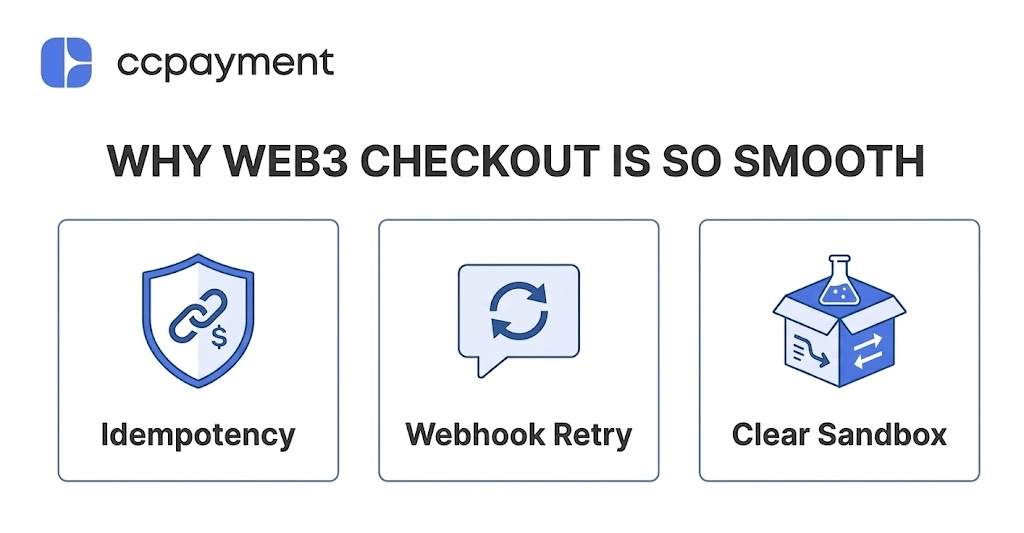
1.1 Idempotency: The Eradication of Duplicate Payments
Idempotency is a core concept in computer science. In simple terms, it means that an operation can be applied multiple times without changing the result beyond the initial application. In the context of a crypto payment API, it is your ultimate safeguard against accidental duplicate charges.
To prevent duplicate transactions caused by network issues, retry mechanisms, etc., the system should use idempotency to ensure that each transaction is processed only once.Use the txid (transaction hash) of the transaction or other unique identifiers as the basis for the idempotency check.
When receiving the deposit notification, check in the database whether the transaction with the given txid has been recorded. If it exists, skip the processing of this transaction to avoid duplicate entries.
1.2 Webhook Retries: Bulletproof Order Fulfillment
In a modern e-commerce ecosystem, communication between the payment processor and the merchant's backend server is handled via Webhooks (Instant Payment Notifications). When a customer successfully sends crypto to the designated address and it confirms on-chain, CCPayment instantly fires a webhook to your server.
But what happens if your server is temporarily down for maintenance? Our engine will automatically wait and retry sending the webhook. The intervals between retries increase exponentially(e.g., after 30 seconds,then 1 minute and 30 seconds,then 3 minutes and 30 seconds, then 7 minutes and 30 seconds, and so on.)until the system completes 6 retries.
1.3 Clear Sandboxes: Risk-Free Developer Environments
Integrating how to accept crypto payments into a complex enterprise tech stack requires rigorous testing. Testing a new payment flow with real money (Mainnet tokens) is stressful, inherently costly due to network gas fees, and prone to expensive mistakes by QA teams.
CCPayment provides a robust, fully featured Sandbox Environment. Your development team can simulate the entire checkout lifecycle from start to finish using Testnet tokens (simulated cryptocurrencies with no real-world financial value). Our Sandbox accurately mirrors the production API's behavior, including network delays, partial payment scenarios, and webhook triggers.
2.Stop Sweating Market Dips: Auto-Settlement
A harsh reality of the current Web3 landscape is that 90% of Web3 merchants fail because they accidentally act like hedge funds rather than software companies or retailers.
When a business decides to integrate a crypto payment solution, they often fall into the trap of holding volatile tokens directly on their corporate balance sheet. Imagine selling a premium software license for $1,000 and accepting payment in Bitcoin. Over the weekend, macroeconomic news causes the crypto market to flash crash by 15%. Suddenly, the revenue from that specific sale is only worth $850.
You still have to pay your cloud hosting providers, your employees' salaries, and your suppliers in fiat currency. Sweating over market dips, constantly monitoring price charts, and actively managing treasury risk takes your focus entirely away from building your actual product.
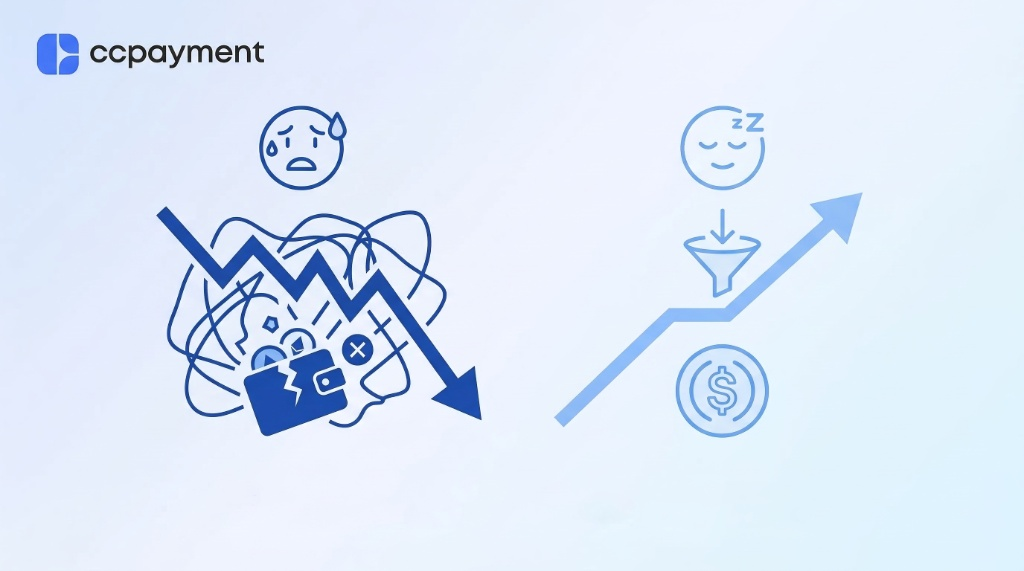
You are building a business, not a trading desk. This is exactly where CCPayment’s Auto-Settlement engine changes the paradigm.
The Mechanics of Stablecoin Auto-Settlement
Stablecoins (such as USDT, USDC, and the newly upgraded USDS) are cryptocurrencies pegged 1:1 to a stable traditional asset, almost exclusively the US Dollar. They offer the borderless, permissionless speed of blockchain technology without the anxiety-inducing price volatility.
How it functions in practice:
| Step | Engine Mechanism | Technical Action |
| 1 | Diverse Acceptance | Enables checkout in BTC, ETH, SOL, DOGE, and dozens of other assets. |
| 2 | Rate Locking | Queries global liquidity providers to lock exchange rates for 15-30 minutes. |
| 3 | Automated Routing | Instantly swaps volatile tokens for stablecoins via decentralized/centralized liquidity pools. |
| 4 | Stable Settlement | Deposits equivalent stablecoin value directly into the secure merchant treasury. |
3.Privacy ≠ Risk: Real-Time KYT Security
The core ethos of the Web3 movement is decentralization, self-custody, and financial privacy. Many cryptocurrency users specifically prefer to transact without uploading their passports, sharing their home addresses, or revealing their physical identities to every online store they visit.
However, for a legitimate registered merchant, this introduces a massive compliance dilemma. Accepting anonymous payments shouldn't put your merchant account at risk of interacting with money laundering rings, hacked funds, or internationally sanctioned entities.
In the past, the only way to ensure crypto payment security was to force every single user through rigorous KYC (Know Your Customer) identity verification processes before checkout. This approach severely damaged conversion rates, causing up to 70% cart abandonment among privacy-conscious Web3 shoppers.
We believe this is a fundamentally flawed approach. In Web3, privacy does not have to equal risk.
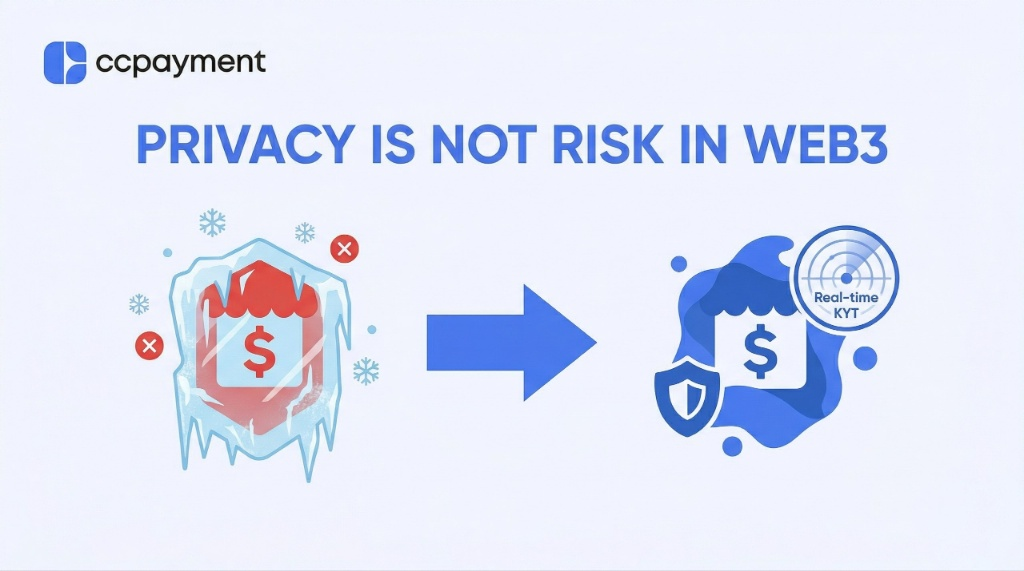
What is Real-Time KYT?
Instead of verifying who the customer is, CCPayment verifies what the funds are using Real-Time KYT (Know Your Transaction). The moment a customer connects their wallet, our engine scans the blockchain history. If the funds originate from a sanctioned or high-risk source, the transaction is instantly blocked. However, we have reserved the flexibility to handle the situation in a flexible manner.You achieve 100% regulatory compliance and crypto payment security without breaking the default user anonymity that Web3 shoppers love.
The Business Impact: You achieve the holy grail of modern Web3 commerce: absolute regulatory compliance without sacrificing the frictionless, pseudonymous user experience that crypto-natives demand. Your corporate treasury remains completely unpolluted, ensuring that you can easily off-ramp your stablecoins to traditional fiat currency at centralized exchanges without fear of frozen accounts or devastating compliance audits.
4.Ecosystem Update: Seamless Support for USDS
As major exchanges and industry leaders outline their conversion timelines for the USDS migration, merchants who fail to adapt their payment infrastructure risk being left behind in the liquidity shift.
As an enterprise-grade crypto payment solution, CCPayment is deeply embedded in the evolving narratives of the broader Web3 ecosystem. We don't just process payments; we actively adapt to underlying infrastructure changes to ensure our merchants are always ahead of the technological curve.
One of the most significant shifts in the decentralized finance (DeFi) landscape right now is the comprehensive upgrade of the DAO ecosystem, which has recently led to the rebranding of the legendary Dai (DAI) stablecoin to the new, enhanced USDS (USDS) token.
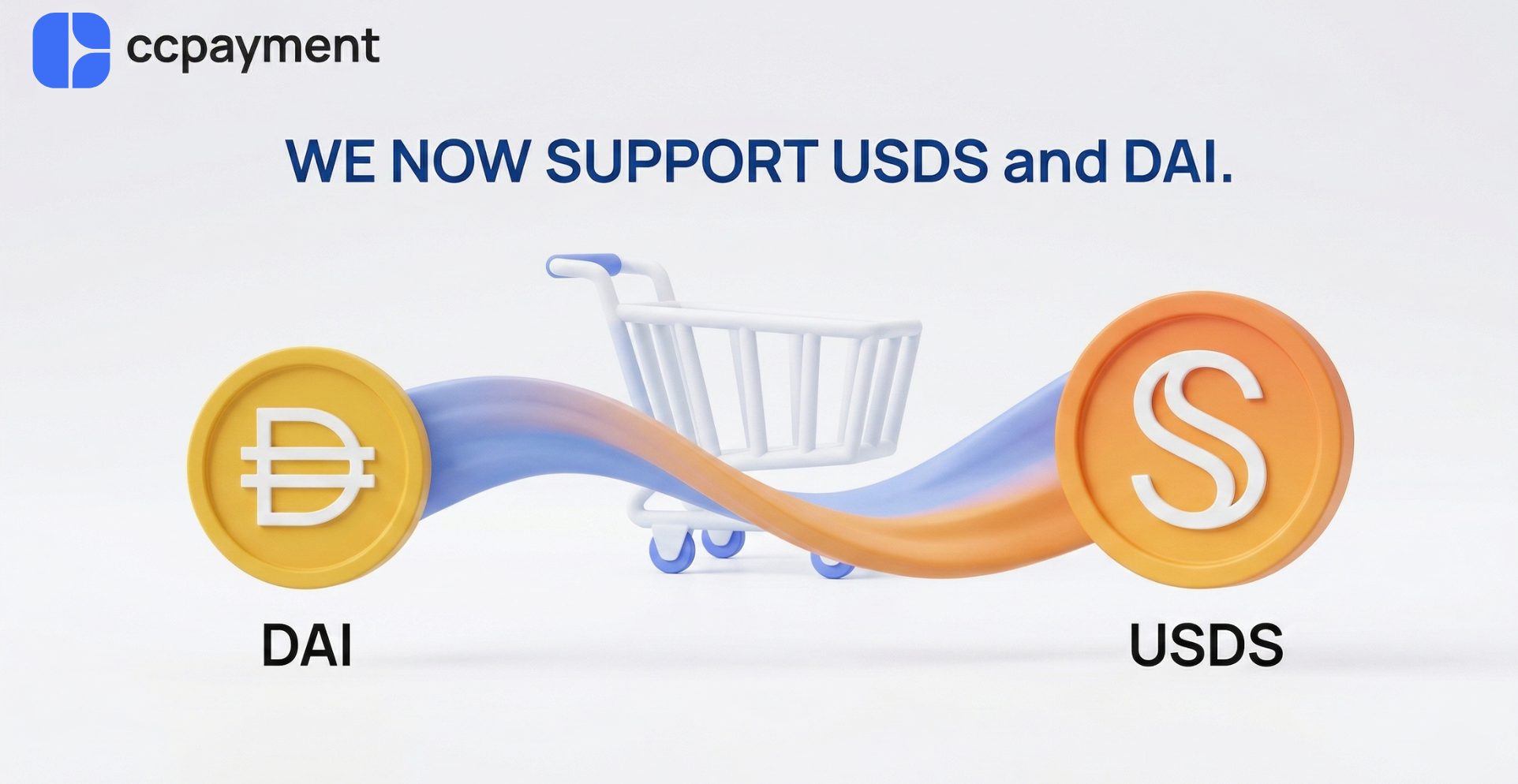
What Merchants Need to Know:
- 🟢 USDS Enabled: Effective April 9, 2026 (18:30 UTC+8), we officially enable deposits, withdrawals, and checkout support for the new USDS stablecoin. (Note: USDS Auto-Swap is currently undergoing liquidity testing and will launch soon).
- 🔄 DAI Swap Discontinuation: The internal swap function for the legacy DAI token will be discontinued simultaneously.
- ✅ Seamless Dual-Token Support: Your original DAI tokens remain fully functional. We support both legacy DAI and USDS simultaneously, ensuring zero disruption to your daily operations.Your assets remain 100% secure. We handle the complex blockchain infrastructure routing on the backend, so you can continue focusing on growing your sales. (For a deeper technical dive into the Sky ecosystem upgrade, we encourage you to read the official community forum).
Want to know how to deploy this frictionless checkout in just 10 minutes? Check out our breakthrough AI SKILL framework.
Ready to Upgrade Your Payment Stack?
The future of commerce is undoubtedly digital, borderless, and decentralized. However, transitioning your business into Web3 should not mean stepping back in time when it comes to software reliability, accounting sanity, or regulatory compliance.
From engineering idempotency to prevent duplicate processing, to auto-settling volatile assets into stablecoins to protect your margins, to leveraging Real-Time KYT to secure your treasury—CCPayment is meticulously designed for serious businesses that want to scale globally.
We handle the mathematical complexity of the blockchain so you can focus entirely on delighting your customers.Are you ready to elevate your Web3 commerce stack? It's time to stop losing customers to clunky checkouts and stop losing sleep over crypto volatility.
Integrate the CCPayment API Today
About CCPayment
CCPayment offers an industry-low 0.2% service fee alongside 900+ cryptocurrency support, protecting your global business 24/7.
🔗 Explore the future of payments: ccpayment.com
🤖 Contact us: @CCPaymentSupportBot
FAQ
Q: How does Real-Time KYT impact the checkout speed for customers?
A: The KYT risk scoring is designed to be highly efficient, typically processing via API calls in milliseconds. Because this screening runs in parallel with standard blockchain confirmation times, it rarely introduces noticeable latency for the shopper, ensuring a smooth checkout flow while maintaining strict compliance standards.
Q: Will the DAO ecosystem upgrade from DAI to USDS affect my current merchant balance or API integration?
A: Your existing DAI balances and current API integrations will remain unaffected during this transition. We have engineered our backend to support both legacy DAI and the new USDS simultaneously, minimizing compatibility issues and allowing your business to manage both assets seamlessly without requiring immediate code changes.
Q: How does the system handle exceptions like customer underpayments?
A: In the event of a partial payment, the CCPayment webhook will immediately notify your server with a "partial" status. The checkout interface is then dynamically updated to prompt the customer to send the remaining balance. The order is only flagged as complete once the full requested amount is verified on-chain.
Q: What happens if our merchant server experiences temporary downtime during a transaction?
A: To mitigate data loss during server outages or network congestion, our infrastructure employs an Exponential Backoff webhook retry mechanism. If your server fails to acknowledge the initial payment notification, our system will automatically schedule retries, and the intervals between retries will gradually increase. A total of 6 retries will be conducted.
Q: Can I customize which cryptocurrencies trigger the Auto-Settlement feature?
A: Yes, the auto-settlement routing is highly configurable within your merchant dashboard. You can set specific rules based on your treasury strategy—for instance, choosing to hold mainstream assets like BTC or ETH directly, while configuring the system to automatically swap other volatile altcoins into stablecoins (like USDT or USDC) upon receipt.